
9 No-Drill Ideas Of Our Renter-Friendly Living Room Tour

When people hear “rental decorating,” most picture bare white walls, vertical blinds, and a landlord who says no to everything. That was my living room too. Our apartment came with beige carpet, off-white walls we’re not allowed to paint, and a lease with the classic line: “no holes larger than a nail hole.” For two years I treated those rules like a stop sign. Then I got tired of living in a waiting room and decided to find out exactly how much cozy is possible with zero wall damage.
The answer is a lot. Our 14-by-16-foot living room now has a gallery wall, curtains, an accent wall, a big mirror, layered rugs, real plants — the whole thing. Nothing is nailed, screwed, or glued to anything the landlord owns. Every piece can come down in an afternoon and leave the walls exactly as we found them. Here are 9 no-drill ideas from the tour, the six rules I live by, and the full budget: about $1,660, spent slowly over a year.
For the budget side of cozy living rooms, my warm minimalist living room ideas pair perfectly with these tricks.
1. Follow the 6 Landlord-Friendly Rules
Before the tour, the rules that keep my security deposit safe. I follow all six, every time, no exceptions. Nothing goes into the wall: no nails, no screws, no anchors — this one rule eliminates 90 percent of landlord problems.
Adhesive is always removable: only products rated damage-free, and I always test a small hidden patch first. Furniture does the heavy lifting: tall bookshelves, leaning mirrors, and console tables create the “architecture” built-ins would provide.
Textiles are my paint: since I can’t paint, color comes from curtains, rugs, and pillows — cheaper than paint anyway, and they move with me. Document everything: I photograph every wall and fixture on move-in day and save it all in a cloud folder. And ask about the gray areas: a two-minute conversation at lease signing saves a lot of guessing.
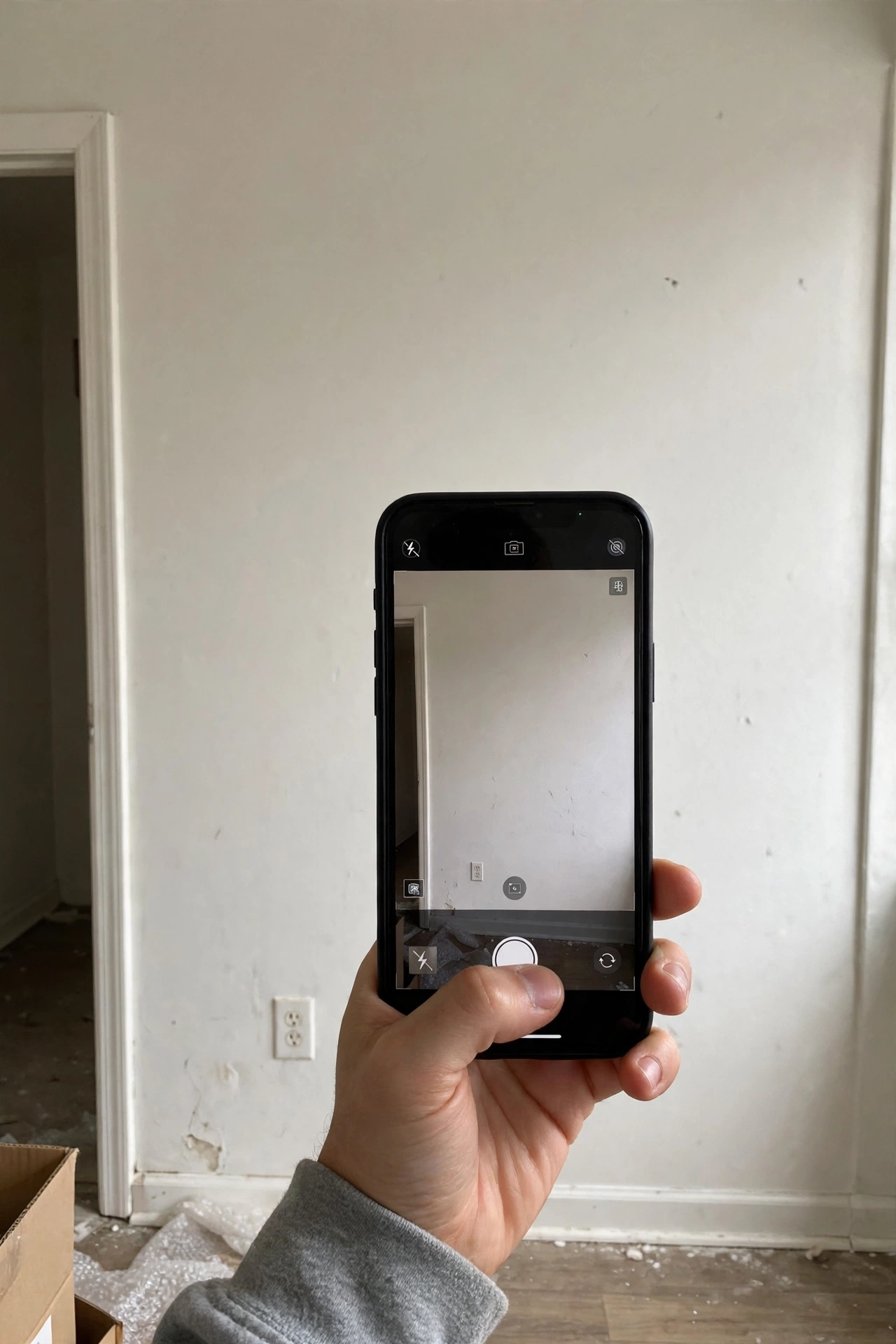
Tip: Do the move-in photo walk on day one, before a single box is opened. Date-stamped photos of every wall are the cheapest insurance policy you’ll ever have.
2. Build a Zero-Nail Gallery Wall
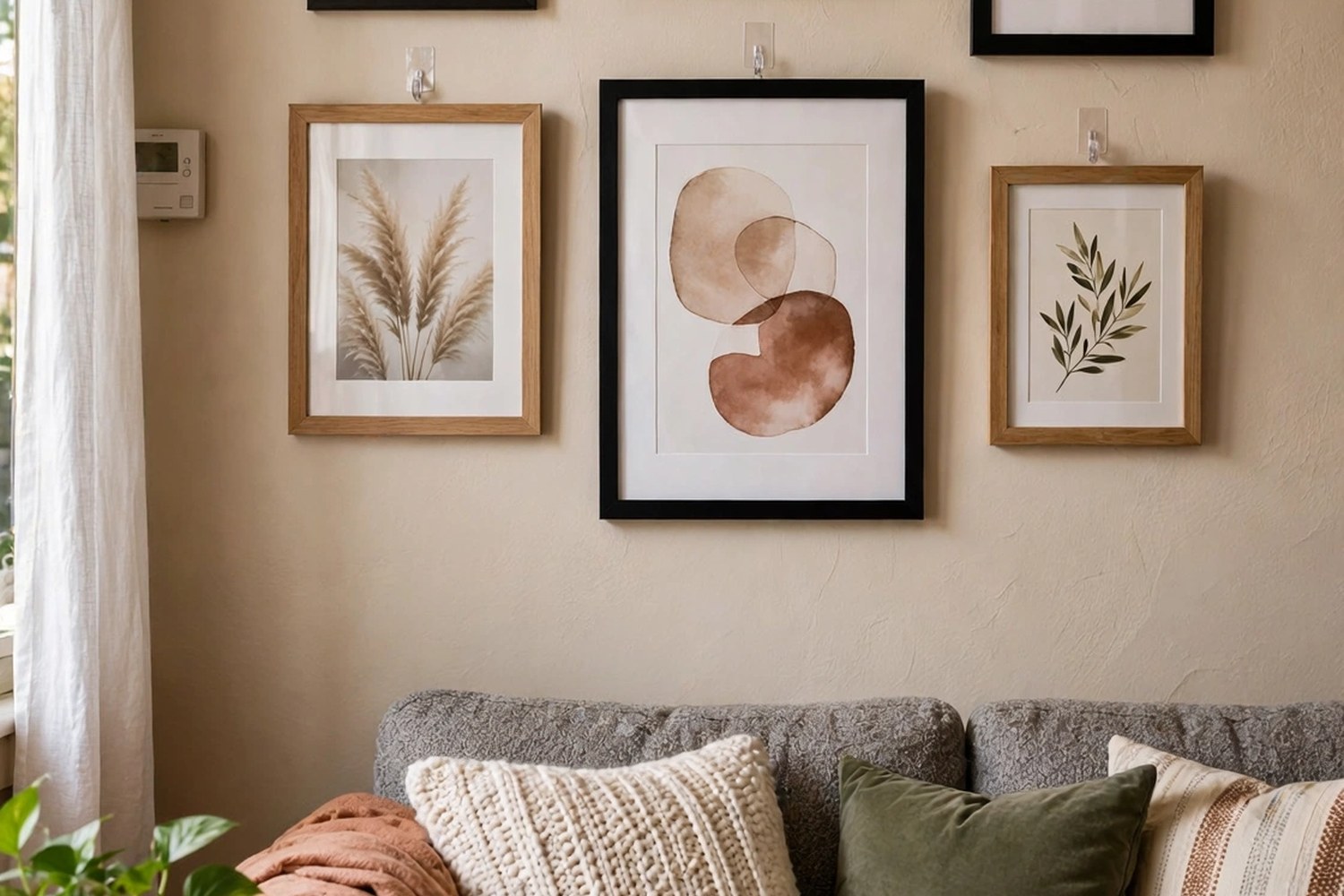
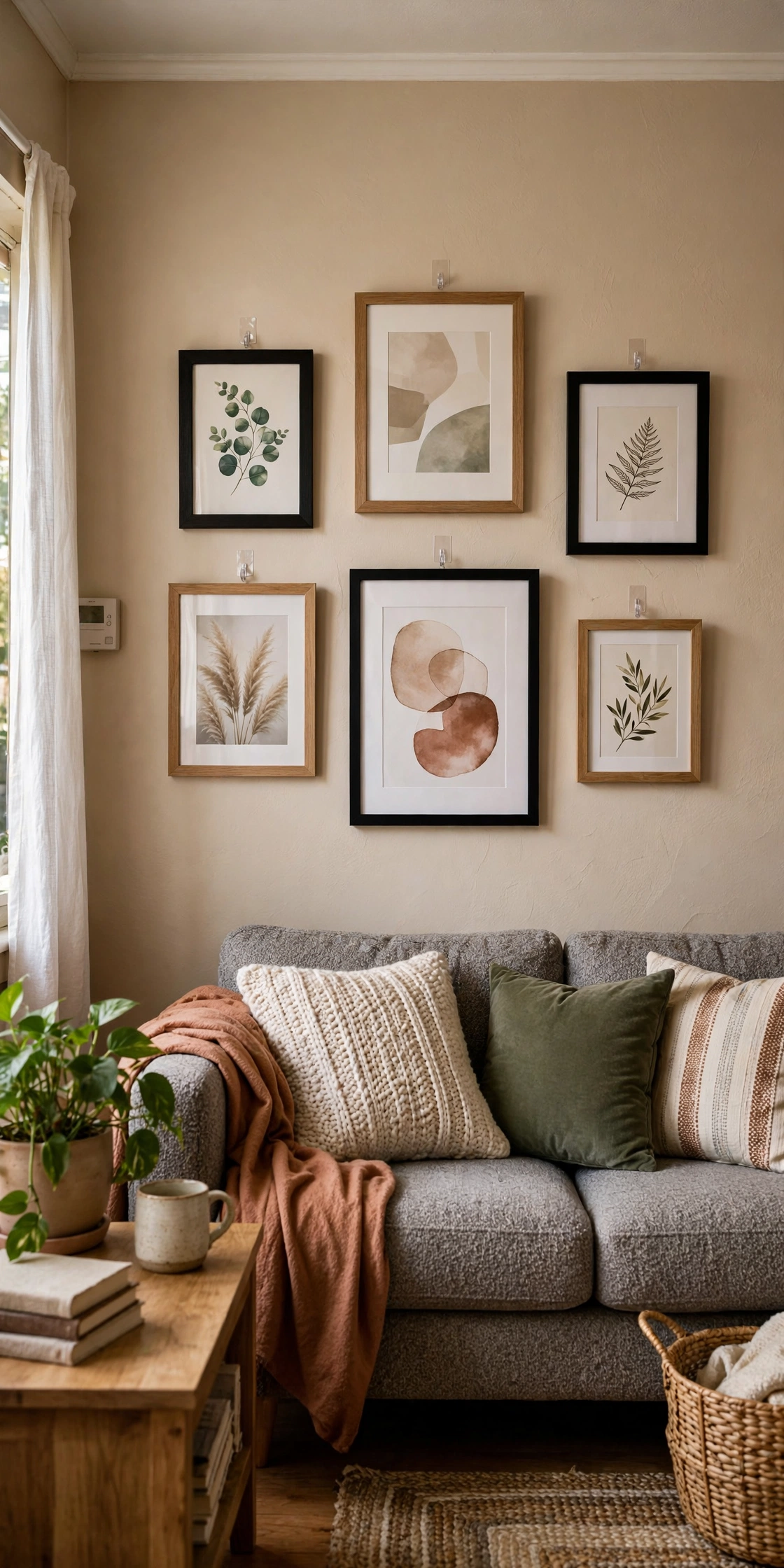
The first thing people notice is the gallery wall above the sofa: eleven frames in mixed sizes, not a single nail. Every frame hangs on adhesive picture-hanging strips rated for its weight, and it’s survived two summers of humidity without a single fall. My gallery wall hanging guide covers the full method, but the short version: lay the arrangement on the floor first and photograph it, cut paper templates and live with the paper version on the wall for three days, then commit.
When you commit, clean each spot with rubbing alcohol first — adhesive bonds to clean paint, not dust. Use two sets of strips for anything over 12 inches wide, press firmly for 30 seconds, and wait a full hour before hanging.
The frames: four I owned, three thrifted at $3 each, four new at $8 each, art mostly cheap prints plus one my sister painted. Total: about $65. It looks like a million bucks and comes down with a slow pull of a tab.

Tip: Moving paper templates is free; moving frames with adhesive strips is annoying. Live with the paper layout for three days before you commit to a single strip.
3. Hang Curtains Without Drilling
Rental windows come with two sad options: vertical blinds or nothing. Ours had vertical blinds, and they stayed — I just made them invisible. A tension rod mounted inside the window frame, hung with curtains that cover the blinds when closed and stack neatly to the sides when open.
Tension rods get a bad rap because cheap ones slip. What works: buy a rod rated for at least twice your curtains’ weight, twist it until you feel real resistance, and check it monthly. Mine have held heavy linen-look curtains over a year without budging ($18 each).
The curtains do enormous work: softness, color, height. I hung them as close to the ceiling as the frame allowed, which makes 8-foot ceilings feel taller. Warm oatmeal panels, $45 per pair on sale, two pairs for fullness. The landlord’s blinds stay pristine behind them. Everybody wins.

Tip: Always buy the rod rated for double the curtain weight. The cheap rod that “should” hold is the one that crashes down at 2 a.m.
4. Try a Peel-and-Stick Accent Wall
The project I was most nervous about became my favorite. One wall — behind the TV console — is covered in peel-and-stick wallpaper in a subtle sage green grasscloth pattern. One Saturday afternoon, $120 for three rolls, and it completely changed the room. Guests assume it’s real wallpaper and don’t believe me until I show them a corner. Honest tips: order one more roll than the calculator says (pattern matching eats paper), start in the least visible corner (your first two strips will be your worst), and smooth from the center outward with the plastic tool.
Removal is what renters care about, so here’s the truth: when we took the same product down in our last apartment, it came off in full strips with zero residue and zero paint damage. Pull slowly at a sharp angle, keeping the paper close to the wall. And only buy rolls explicitly labeled “renter-friendly” from brands with real removal reviews. Cheap no-name rolls are where the horror stories come from.
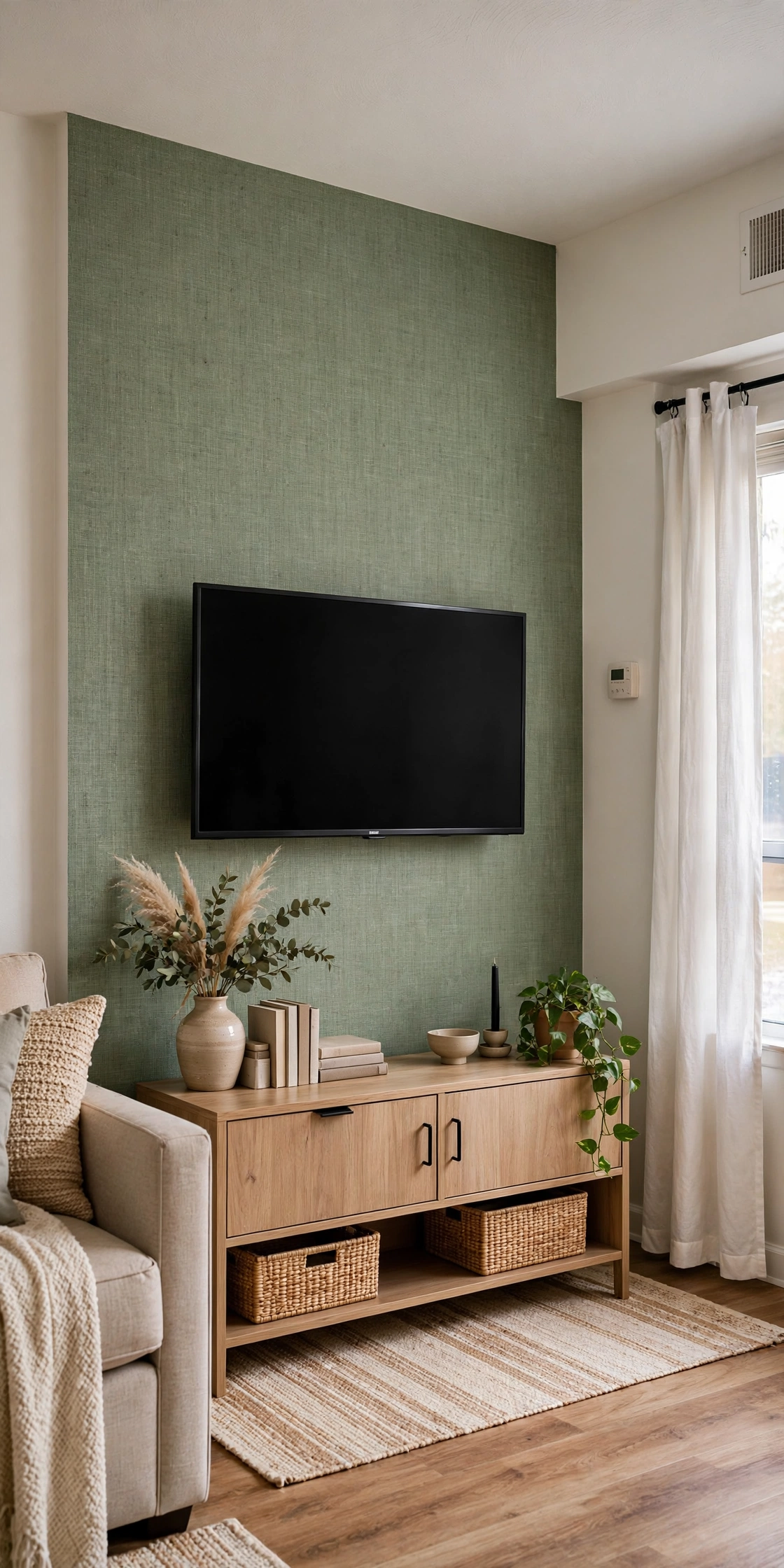
Tip: Photograph the wall behind furniture before you start, and keep one leftover strip. Future you will need it for the corner nobody talks about. Apartment Therapy’s renter-friendly living room makeover shows another no-paint transformation.
5. Let Furniture Do the Heavy Lifting
The biggest pieces needed zero wall involvement by design. The sofa is secondhand — a solid wood-frame three-seater found online for $250, boring beige, rescued by a washable slipcover in warm white ($90). A slipcover is the renter’s secret weapon: it makes any ugly-but-comfortable sofa look intentional, it goes in the washing machine, and it moves with you. Under it, the beige original stays pristine for whoever owns it next.
The rug deserved real thought because of the beige wall-to-wall carpet we can’t remove. Layering a rug over rental carpet works beautifully if you go big enough: an 8-by-10 ($280) covers most of the seating area and reads as the “real” floor.
Low-pile pattern in cream, rust, and sage hides everything, and a $40 rug pad underneath keeps it from sliding — the one thing people forget. Layout: sofa facing the room, two armchairs opposite (one thrifted $60, one new $140), round coffee table in the middle ($110 secondhand). Pull the sofa 6 inches off the wall and the room actually feels bigger.
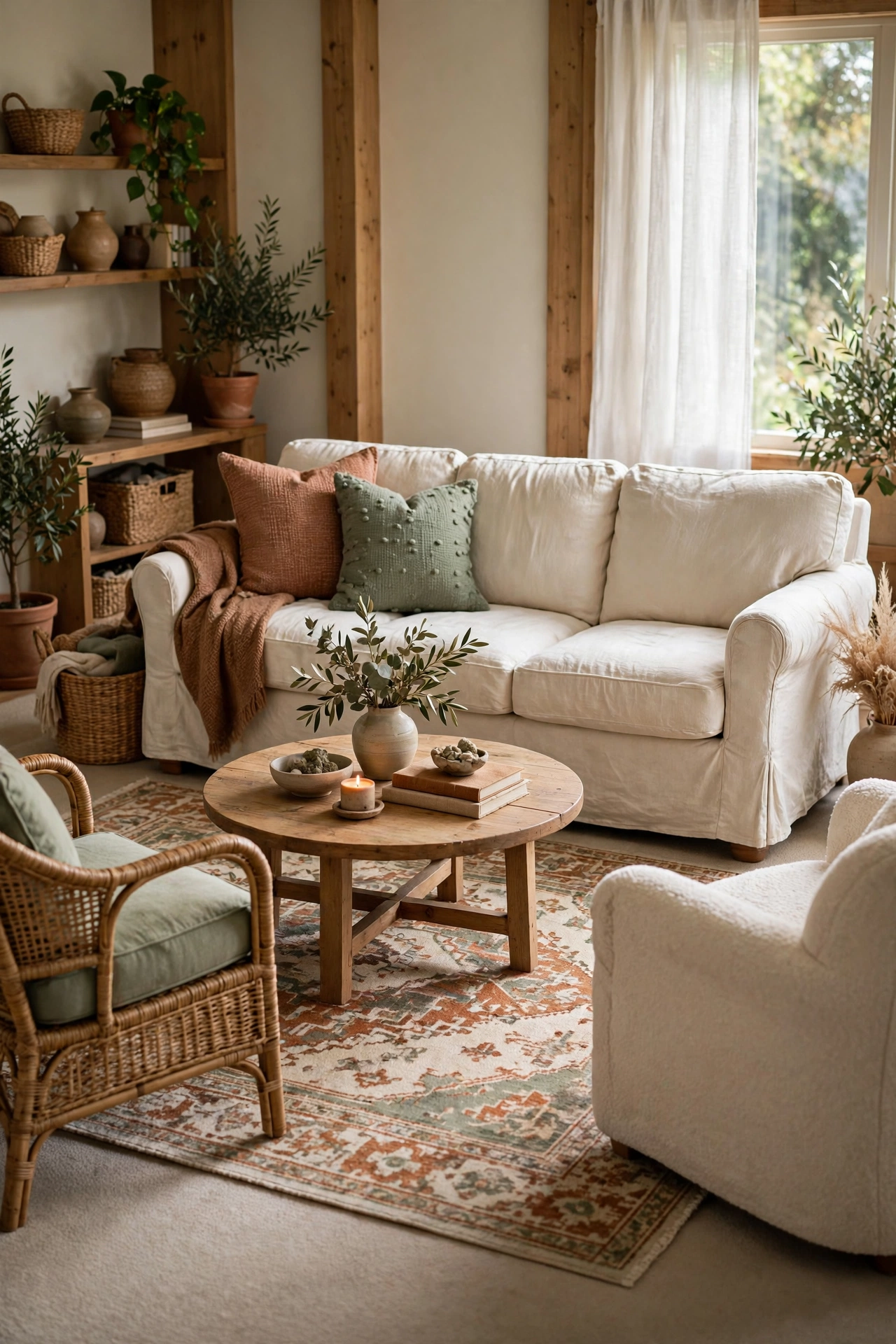
Tip: When layering over rental carpet, go bigger than you think. A too-small rug on carpet looks like a postage stamp; an 8×10 anchors the whole seating area.
6. Lean a Big Mirror
The mirror does quiet work on the wall opposite the window: a 5-foot-tall leaning floor mirror ($110) that needed zero mounting hardware because it leans. It doubles the daylight and makes the 14-foot dimension feel closer to 18. If you buy one rental piece, make it a leaning mirror. The return on investment is absurd.
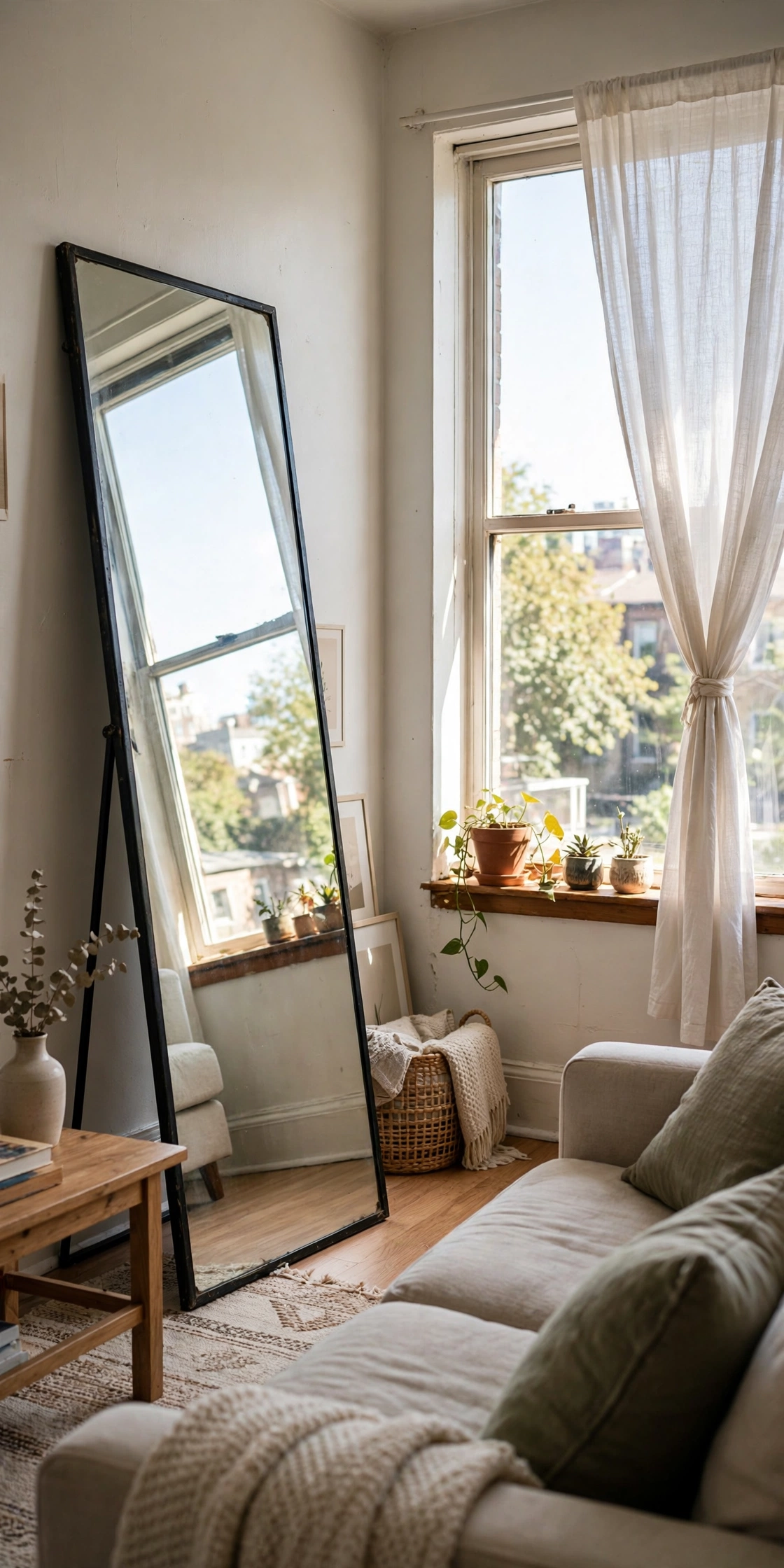
Tip: Place the leaning mirror where it catches a window’s reflection. Doubled daylight is free square footage — no landlord approval required.
7. Put Plants at Eye Level
Plants are a renter’s best friend: color, height, and texture with zero installation. I have seven: a tall fiddle-leaf fig in the corner ($45), three pothos trailing from a tension rod mounted high in the window frame (rod $12, plants $8 each), and small succulents on the shelves. The tension-rod plant display is my favorite no-drill trick in the whole apartment — greenery at eye level where a shelf would go, with no holes at all.

Tip: Check the tension rod monthly like the curtain ones. Plants are heavier than fabric, and a slipped rod means a soil disaster on your rental carpet.
8. Light It With Lamps Only
Same rule as the bedroom: no overhead light after dark. Two table lamps with warm 2700K bulbs ($70 for the pair) flank the sofa on side tables, and a floor lamp with a linen shade ($65) arcs over the reading chair in the corner. The ceiling fixture stays off approximately forever. Total lighting cost: $135, and the room glows like honey in the evening.

Tip: Put the two sofa lamps on one plug-in dimmer. One slider takes the whole room from “guests are over” to “movie night” in a second.
9. Track Every Dollar
Here’s the full receipt, because renter decorating has a reputation for being either impossibly cheap or secretly expensive: secondhand sofa $250, slipcover $90, 8×10 rug $280, rug pad $40, peel-and-stick wallpaper $120, gallery wall $65, adhesive strips $25, tension rods $36, curtains $90, armchairs $60 + $140, coffee table $110, TV console $130, leaning mirror $110, table lamps $70, floor lamp $65, plants $85, plant rod $12, pillows and throws $95, side tables $40. Total: about $1,660, spent gradually over a year.
Not a single dollar is stuck to the landlord’s walls. When we move, all of it comes with us. That’s the part I love most: every piece is an investment in our home, not in someone else’s property. For the rest of the house on the same spirit, my room refresh ideas under $50 keep costs low everywhere.

Tip: Spread big purchases across months and buy the “architecture” pieces first — rug, mirror, curtains. They define the room; the decor fills in naturally afterward.
Which No-Drill Trick Is Worth It?
| Trick | Cost | Best for |
|---|---|---|
| Adhesive-strip gallery wall | ~$65 | Biggest wow per dollar |
| Peel-and-stick accent wall | ~$120 | Real color, zero paint |
| Leaning floor mirror | ~$110 | Doubled daylight |
| Tension-rod curtains | ~$126 | Hiding sad blinds |
| Washable slipcover | ~$90 | Ugly sofa rescue |
| Layered rug over carpet | ~$320 | The “real” floor |
Will adhesive strips damage the paint when removed?
Used correctly — clean wall, proper weight rating, slow pull at a sharp angle — they come off clean. I have move-out photos from our last apartment to prove it. Always test a hidden patch first.
Does peel-and-stick wallpaper really come off cleanly?
The renter-friendly kind does: full strips, zero residue, zero paint damage. Buy only rolls explicitly labeled removable from brands with real removal reviews. Cheap no-name rolls are where horror stories come from.
Can you really layer a rug over wall-to-wall carpet?
Yes, if the rug is big enough (8×10 for a seating area) and you use a rug pad underneath to stop sliding. It reads as the “real” floor and hides the beige completely.
My landlord allows small nail holes. Should I still go no-drill?
A two-minute conversation at lease signing settles it. If they truly don’t mind filled holes, use them where it matters. But every no-drill trick here works just as well, and your move-out will be an afternoon instead of a weekend.
How do I hang curtains with no drilling at all?
Use a tension rod mounted inside the window frame, hung as close to the ceiling as the frame allows. Buy a rod rated for at least twice your curtains’ weight, twist until you feel real resistance, and check it monthly. Cheap rods slip; good ones hold heavy linen for years.
Can peel-and-stick wallpaper go on textured walls?
Smooth walls work best. Heavy texture weakens the bond and shows through the paper. Test one full strip first and live with it a week before committing. On light orange-peel texture, busier patterns hide imperfections better than flat solids.
Final Thoughts
Here’s the thing nobody tells you about decorating a rental: the constraints make you more creative, not less. If I owned this place, I’d have painted the walls and called it done. Because I couldn’t, I learned about tension rods and slipcovers and peel-and-stick paper — tricks I’ll use forever, in any home, rented or owned. There’s also something freeing about knowing it all comes down: I take bigger risks with pattern and color because nothing is permanent. So if you’re renting and waiting to “really” decorate until you buy a place, consider this your permission slip to start now. Your home is where you are, not where you’ll be someday. Hang the curtains with a tension rod. Lean the giant mirror. Take the move-in photos, follow the six rules, and make it yours. Future homeowner you will thank renter you for all the practice. More renter-friendly ways to make a bare apartment feel finished.

