
Flocked Christmas Tree Decor Ideas


A flocked Christmas tree changes the decorating math. On a green tree, the branches disappear behind the ornaments; on a snowy one, the white branches ARE the decoration, and everything you hang has to share the stage with them. Colors read brighter, shiny finishes can vanish, and a heavy hand hides the thing you paid for. The 15 ideas below are all built for full-size flocked trees, and each one starts from how flocking behaves: how it scatters light, how it changes contrast, how gently it wants to be handled. If your taste runs to a calmer whole-house approach, our simple Christmas decor ideas make a lovely backdrop for one statement snowy tree.
Key Takeaways
- Flocking is texture, not background: two or three colors and a lighter hand beat a crowded tree, because the snow is doing decorative work.
- Warm amber and warm-white light makes flocking glow; cool white light flattens it. Bury the strands deeper than you would on a green tree.
- Every palette behaves differently on white — silver can disappear, jewel tones double in intensity, and neutrals turn serene instead of muddy.
- Lightweight decor wins: bead garlands over heavy swags, big ornaments deep and small ones at the tips, so the snowy silhouette survives.
- Flock care is part of decorating: gentle handling, dry dusting, gloves for setup, and cool, dry storage keep the snow on the tree for years.
1. Choose Your Flock Level First: Light Dusting or Full Snowfall
Before a single ornament comes out, look at how much snow your tree is actually wearing. Flocking is a fiber coating — usually cellulose or plastic — sprayed onto the branches, and it comes in real degrees: trees sold as “frosted” carry a light dusting concentrated on the branch tips, with plenty of green showing through, while heavily flocked trees are nearly all white, as if they stood through a storm. Neither is better, but they decorate very differently.
A lightly flocked tree still behaves partly like a green tree: it can carry more ornaments and deeper colors without looking busy. A heavily flocked tree is already a finished statement, and it asks for restraint — fewer pieces, paler finishes, room for the white to breathe. Deciding which tree you own is the step that makes every palette choice below fall into place.

Tip: Photograph your undecorated tree in daylight before you start. The photo shows the true flock level — and how much green is really showing — more honestly than your eye does in a lamplit room.
2. Warm the Snow: Amber and Warm-White Lights, Tucked Deep
Light is where flocked trees break the usual rules. Cool white and blue-white strands flatten flocking into a greyish blur, but warm white and amber light makes the white coating glow from inside, the way late sun hits real snow. It is the single highest-impact choice on this list, and it is why so many flocked trees are sold pre-lit with warm bulbs.
Placement matters more than on a green tree, too. Flocking scatters light, so a strand sitting on the surface just makes bright spots; weave the lights deeper into the branches, closer to the trunk, and let the snowy outer tips diffuse the glow. If you are adding lights to an unlit flocked tree, lift branches rather than dragging strands across them — the coating rubs off under friction.
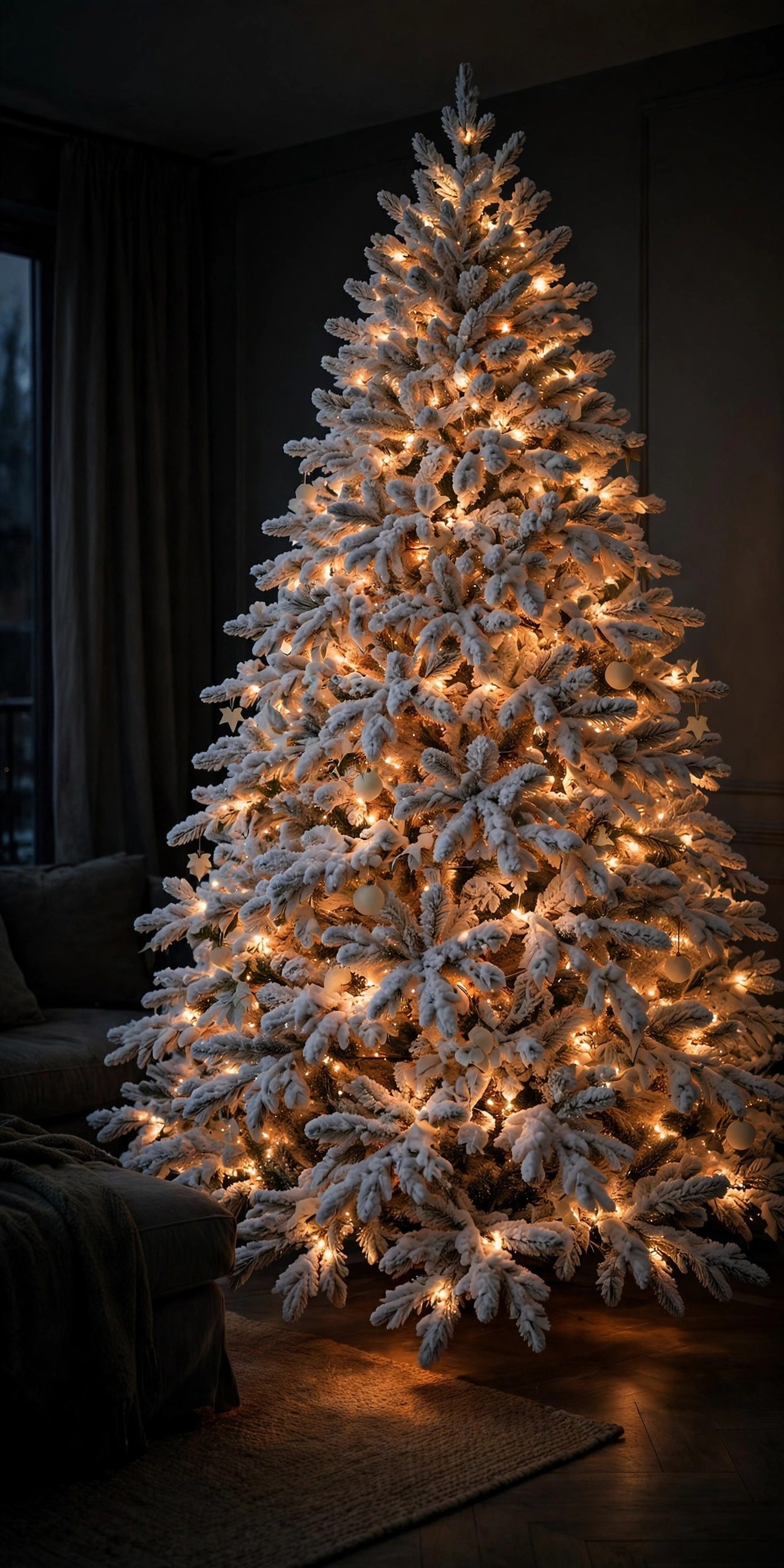
Tip: Test one strand before committing. Light just the bottom third of the tree at dusk, step across the room, and check the color temperature against your walls — warm light should read golden, never orange.
3. Go White-on-White, and Let Texture Do the Talking
The most elegant flocked look uses almost no color at all: white and ivory ornaments on white branches. It sounds like a recipe for invisibility, and on a green tree it would be. On flocking, it works because the tree is not one white but dozens — matte snow, shadowed green under it, bright tips — and ornaments in different finishes give the eye plenty to read.
The whole trick is finish contrast. Mix matte white baubles with glossy ones, pearl and iridescent glass with flat ceramic, a little clear glass for sparkle, and one soft texture such as felt or knit. Hold the palette to whites and ivory only and let the finishes separate the pieces. The result is calm, bright, and quietly luxurious — and the easiest scheme to live with.

Tip: Stand back every few ornaments. White-on-white is built at a distance: if pieces blur together from across the room, swap the next one for a glossier or clearer finish rather than adding color.
4. Pick Metallics That Still Read on White Branches
Metallics are the classic flocked pairing, but white branches sort them ruthlessly. Bright silver and chrome can disappear entirely against heavy flocking — same value, same cool temperature — while warmer metals hold their own. Champagne, brushed gold, and rose gold read clearly on snow because their warmth contrasts with the cool white, and mercury glass, with its mottled antique finish, shows up better than mirror-polished silver for the same reason.
Build a metallic scheme in layers of finish rather than color: matte champagne as the base, a smaller share of glossy gold for highlights, and clear or iridescent glass for sparkle. Two to three metals is plenty. If silver is the metal you own and love, hang it in the shadowed interior, where the darker background gives it contrast.
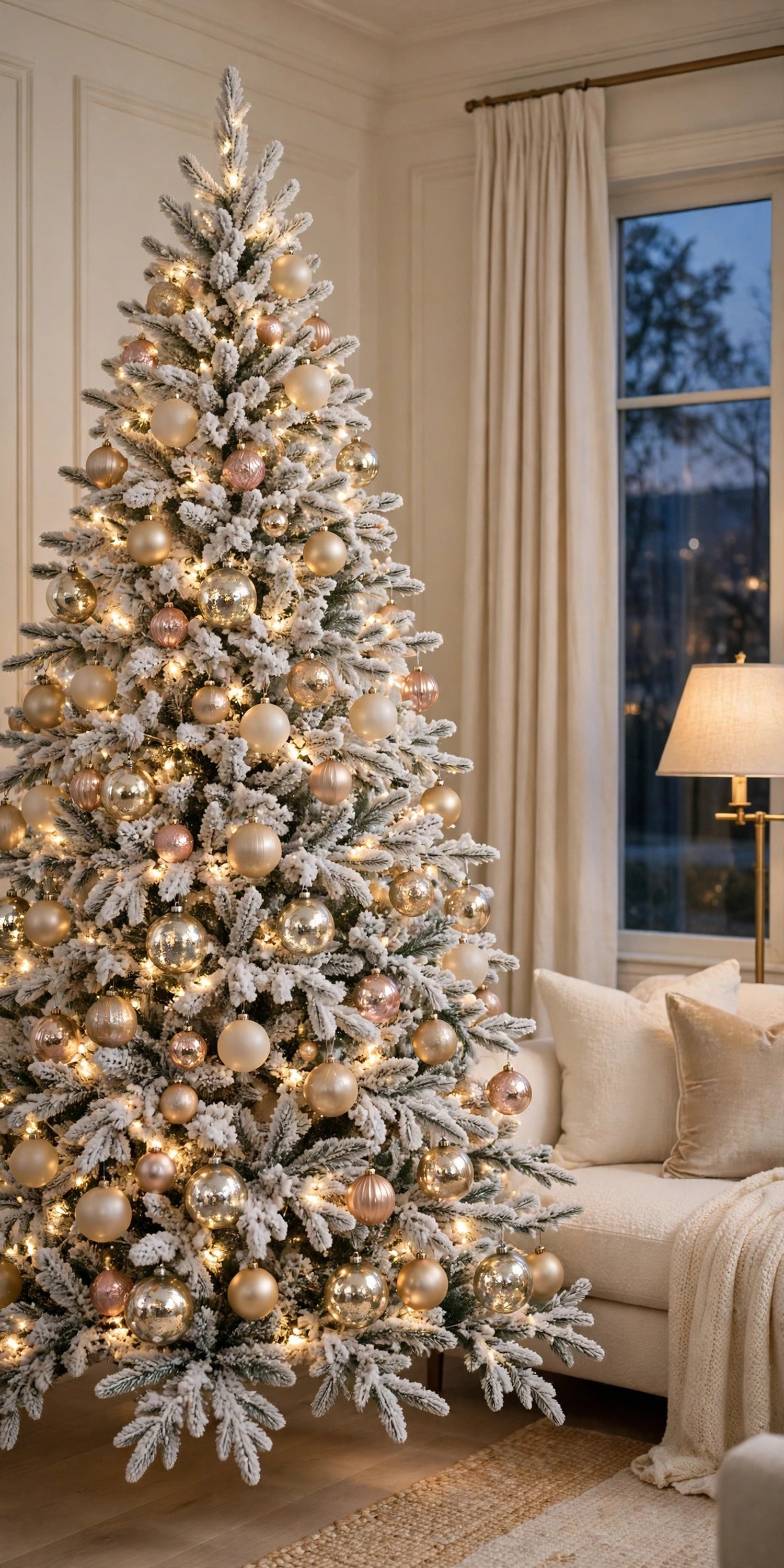
Tip: Hold a test ornament against the tree in daylight and again at night under the tree lights. A metal that reads at noon can vanish by evening — champagne and gold hold up best in both.
5. Let Jewel Tones Pop — They Go Brighter on Snow
Emerald, sapphire, ruby, and deep teal behave completely differently on a flocked tree than on a green one. Against green, jewel tones blend into rich depth; against white, they jump. Every ornament reads at roughly double intensity, like ink on paper, which means a jewel-tone flocked tree needs far fewer ornaments than you would expect — and looks expensive with remarkably little on it.
Choose two jewel tones at most, emerald with sapphire or ruby with deep teal, and mix matte and shiny finishes within each color so the saturation does not go flat. Space the pieces generously and let whole branches stay bare and snowy between them — the white space is what makes the color look deliberate instead of loud.
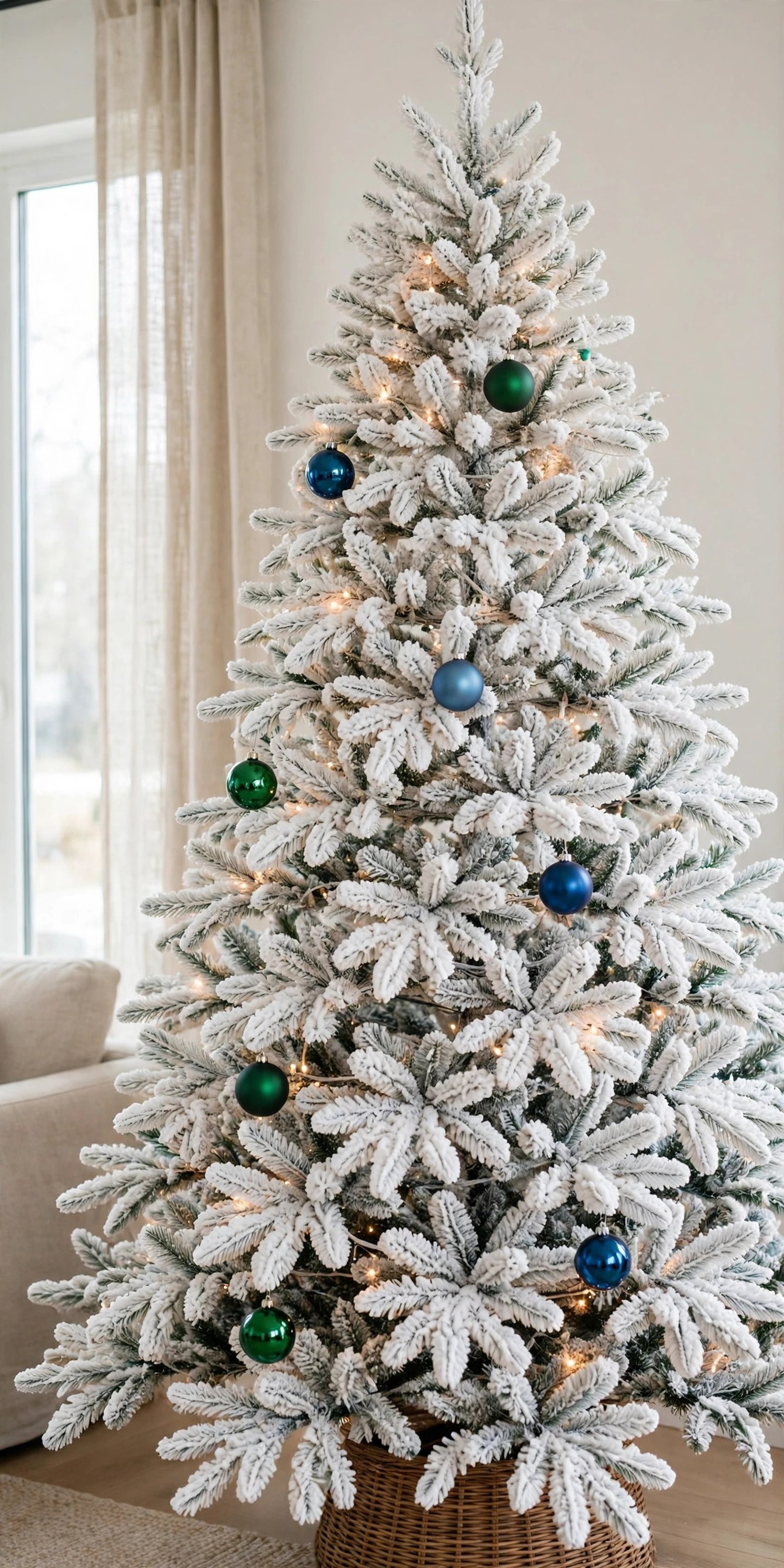
Tip: Hang jewel tones slightly deeper in the branches than feels natural. The snowy tips in front of them soften the saturation a touch and give the color a framed, frosted edge.
6. Go Bold on Purpose: Deep Red or Black for Contrast
There is one deliberate exception to the soft, frosty schemes: drama. Deep red — burgundy, wine, cranberry — against white branches is a high-contrast, storybook look, and matte black ornaments on a heavily flocked tree are strikingly modern. Both work because the contrast is total. What does not work is drifting into them halfway, mixing a bold accent color into a pale scheme and muddying both.
So commit. For the red version, keep everything else white, ivory, or clear glass, and let red carry the tree in matte and velvet finishes more than gloss. For black, pair it with white and one warm metal, and keep shapes simple and graphic. Bold palettes forgive a sparse tree, too: a few dozen well-spaced statement pieces look intentional, not unfinished.
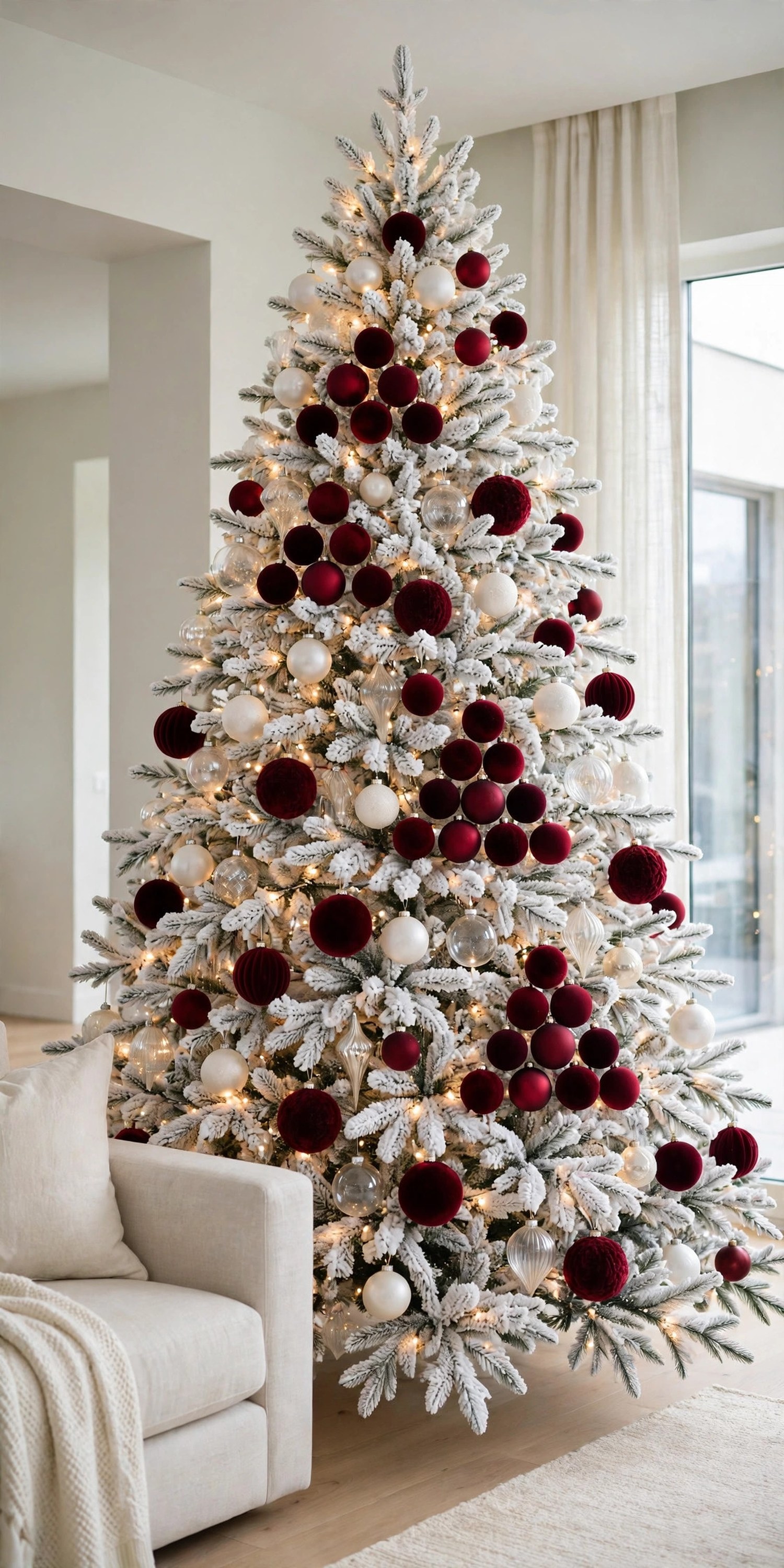
Tip: With high-contrast colors, spacing is everything. Distribute pieces in loose triangles down the tree rather than even rows, and resist filling the last gaps — the white between them is the design.
7. Soften It with Earthy Neutrals: Wood, Cream, and Warm Taupe
Neutrals that can look muddy on a green tree turn serene on a flocked one. Cream, warm taupe, natural wood, and soft beige sit close to white in value but warmer in temperature, so the whole tree reads like a winter landscape in one soft register. It is the coziest of the flocked palettes, and the kindest to a mixed ornament collection you already own.
Texture carries this scheme, since the colors will not do it. Pair matte ceramic and unfinished wood with one gentle shine — a little champagne glass or a few pearl-finish pieces — and add soft materials where you can: felt, knit, and paper all sit comfortably here. Keep greens out of the ornament palette entirely; the green under the flocking is already the tree’s cool note, and the neutrals are there to warm it.

Tip: Pull one neutral from your room — the sofa fabric, the rug, the curtain color — and repeat it on the tree. The tree then looks chosen for the room instead of decorated in isolation.
Flocked Tree Palettes at a Glance
| Palette | Best finishes on flocking | Watch out for |
|---|---|---|
| White-on-white | Matte, gloss, pearl, clear and iridescent glass mixed | Blur — vary finishes, not colors |
| Warm metallics | Champagne, brushed gold, rose gold, mercury glass | Bright silver vanishing against heavy snow |
| Jewel tones | Emerald, sapphire, ruby in matte and shiny mixes | Oversaturation — two tones max, generously spaced |
| Dramatic contrast | Deep red velvet and matte, or matte black | Half-measures — bold only works committed |
| Earthy neutrals | Matte ceramic, natural wood, felt, a touch of champagne | Flatness — texture has to do the work |
| Rustic snow | Paper, pale wood, frosted berries and cones | Anything glossy reads off-theme |
8. Tuck In Frosted Naturals: Glittered Pinecones and Frosted Berries
Natural accents work on a flocked tree only when they look like they survived the same snowfall. A plain brown pinecone reads as a mistake against white branches, but a frosted or glittered one — edges tipped white, as if the snow settled on it too — belongs completely. The same goes for berries: frosted red or white berries echo the coating, while glossy bare berries fight it.
Placement is the old woodland trick, and it suits flocking especially well: tuck naturals deep, where branches meet the trunk, rather than on the outer tips. The snowy silhouette stays clean, and the cones and berries read as discoveries inside the tree instead of decorations stuck on it. Pinecones are the budget hero here — gathered ones just need a thorough low-heat bake to clean them and open them fully before any frosting goes on.

Tip: Frost plain cones yourself with a light touch: white craft paint on the scale edges only, or a dusting of glitter over spray adhesive. Heavy coatings look fake; a hint of white looks like weather.
9. Skip the Heavy Garland — Use Beads or Pearl Strands
Thick garlands are flocking’s enemy twice over. Their weight presses on coated branches and flattens the fluffy outline you chose the tree for, and every removal drags across the coating and rubs more of it off. A heavily swagged tree can lose a visible amount of its snow in a single season of garland going on and off.
Swap the swag for something with air in it: wood bead strands, pearl garlands, or thin bead ropes, draped loosely so they hang in the gaps between branches rather than lying across them. The garland line still gives the tree its finished feeling, but the flocking underneath survives it. Drape in shallow curves, anchor at the trunk, and keep strands off the outermost tips.
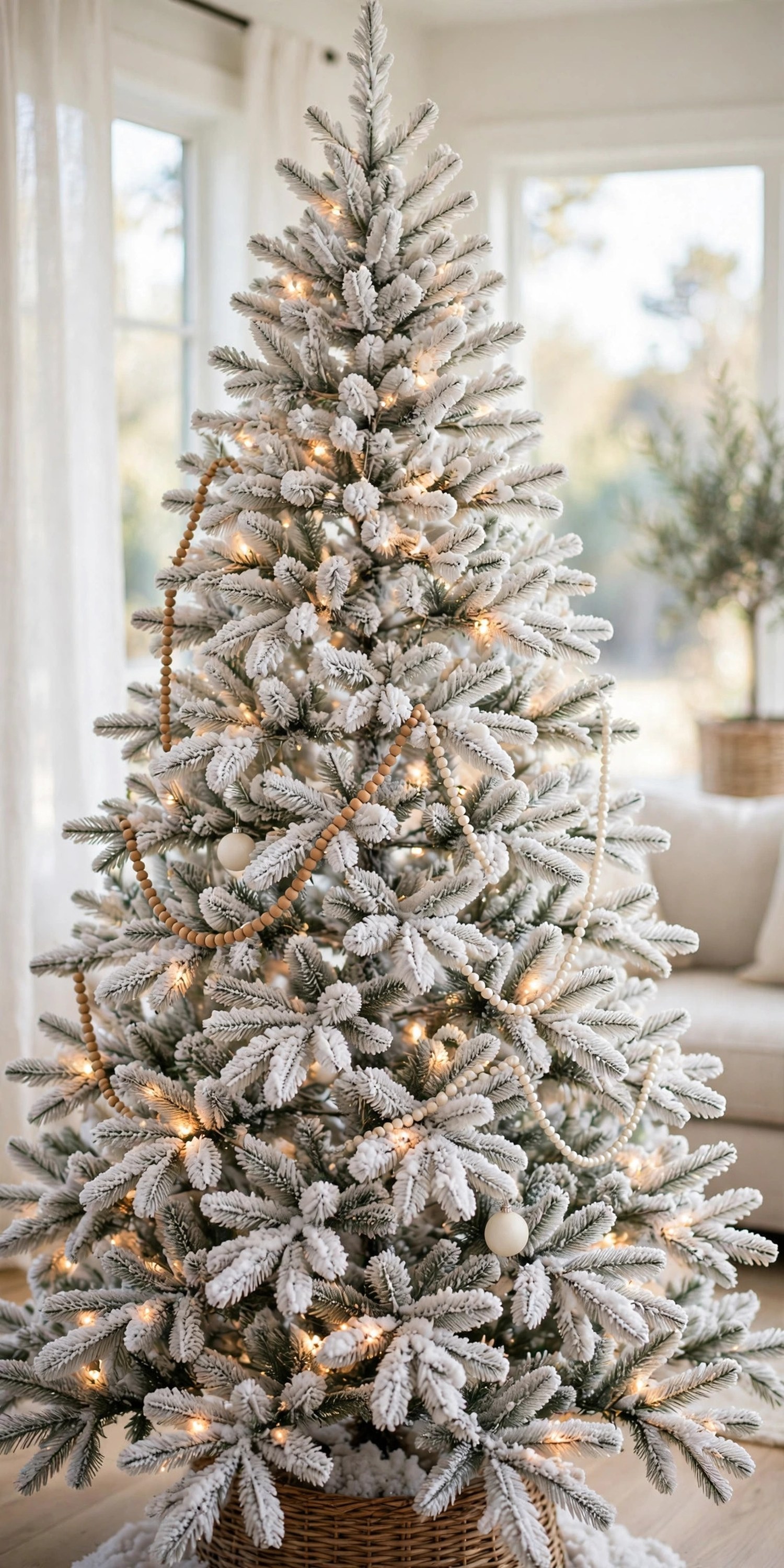
Tip: Put garland on last and take it off first. Every other ornament can go on and off around it, and the strands spend the fewest possible minutes being handled.
10. Layer Inside-Out So the Snowy Tips Stay Visible
On a green tree, layering hides the mechanics. On a flocked tree, layering protects the whole point of the tree: the snow lives on the outer branch tips, and if those get buried behind ornaments, the tree reads as a plain tree with white stuff inside it. So decorate in the opposite direction to instinct — the biggest ornaments go deepest, seated into the interior, and the smallest, lightest pieces ride the outer third.
Work in three loose passes: statement pieces deep and at eye level first, mid-size ornaments in the middle layer, then small, delicate pieces toward the tips. Step back after each pass. A flocked tree is finished earlier than a green one — when the silhouette still shows snow from across the room, stop, even if the ornament box is not empty.

Tip: Keep the very ends of the branches bare on purpose. A fringe of untouched snowy tips all over the tree is what makes guests say it looks like real snowfall.
11. Finish the Base Like a Snowdrift: A White Faux-Fur Skirt
The base of a flocked tree is where the snowfall story either lands or falls apart. A red or plaid skirt argues with the tree; a white one completes it. A white faux-fur skirt, a fluffy white throw arranged in soft folds, or even a plain white blanket tucked around the stand reads as a snowdrift the tree is standing in — the ground that matches the branches.
There is a practical bonus: some shedding is a fact of flocked life, especially at setup, and shed flock dusting a white skirt is invisible, while the same dusting on a dark wood floor announces itself daily. Keep gifts wrapped in whites, creams, and your palette colors so the whole footprint of the tree stays in the winter register, and shake the skirt out outdoors at season’s end.

Tip: Let the skirt be generous and slightly rumpled, not stretched flat. Soft, uneven folds catch light the way real snowbanks do; a taut circle looks like a tablecloth.
12. Try Paper Stars and Pale Wood for a Quiet Rustic Look
For a flocked tree with a Scandinavian heart, paper and pale wood are the perfect materials: matte, lightweight, and exactly the softness of the snow around them. Paper stars in white and cream, folded paper ornaments, and unpainted or whitewashed wood pieces hang light on coated branches — important, since heavy ornaments drag flocked tips downward — and their flat finishes keep the tree calm and handmade in feeling.
Hold the palette tight: white, cream, natural paper, pale wood, and if you want one color, a muted brick red used sparingly. This is also the most forgiving scheme for a tree in its later years — when flocking has thinned a little, matte paper and wood draw the eye with shape and shadow, and nobody notices the snow is not brand new.

Tip: Mix star sizes but keep them in one plane of the tree’s depth, around the middle layer. Paper silhouettes layering over each other at different depths can look tangled up close.
13. Rest a Matte Ribbon Loosely — Never Wrap It Tight
Ribbon has a place on a flocked tree, but it is a supporting role. A tight spiral wrap is wrong for two reasons: crushing ribbon against coated branches rubs flocking off along the whole spiral, and a neat, shiny wrap fights the soft, irregular look of snow. What works instead is a loose, matte ribbon — linen-look, velvet, or raw silk in a palette color — draped in long, relaxed falls from the top, resting on branches rather than binding them.
Let a few wide tails drift down through the branches at uneven lengths, or rest one generous bow where a branch cluster gives it a natural shelf. Matte finishes matter here: shiny satin slides visually off the snow, while velvet and linen look absorbed into it. And keep it to one ribbon treatment — on flocking, a little ribbon goes a very long way.

Tip: Anchor ribbon tails with a gentle twist of floral wire around a branch deep inside the tree, never by tying around the flocked outer branch itself — the coating survives, and the drape looks unforced.
14. Touch Up Bare Spots and Flock a Plain Tree Yourself
Flocking is not permanent, and it does not have to be perfect to be lovely — but worn patches and one rubbed-bare branch can nag at you all season. Touch-ups are genuinely doable: spray-snow and flocking products made for home use can refresh a thin spot or add snow to a plain artificial tree, and a small area is a forgiving place to learn. Work outdoors or over a drop cloth, wear gloves, apply in light passes, and let each pass dry before judging it — flocking always looks heavier once it sets.
You can flock a real tree, too, though it changes the tree’s afterlife: many curbside tree-recycling and mulching programs will not accept a flocked tree, so check your local rules before you spray, not in January. A plain artificial tree you flock yourself is the more flexible project — and if a first attempt lands unevenly, remember that real snowfall is uneven too. Ornaments layered as in idea 10 hide a multitude of beginner patches.
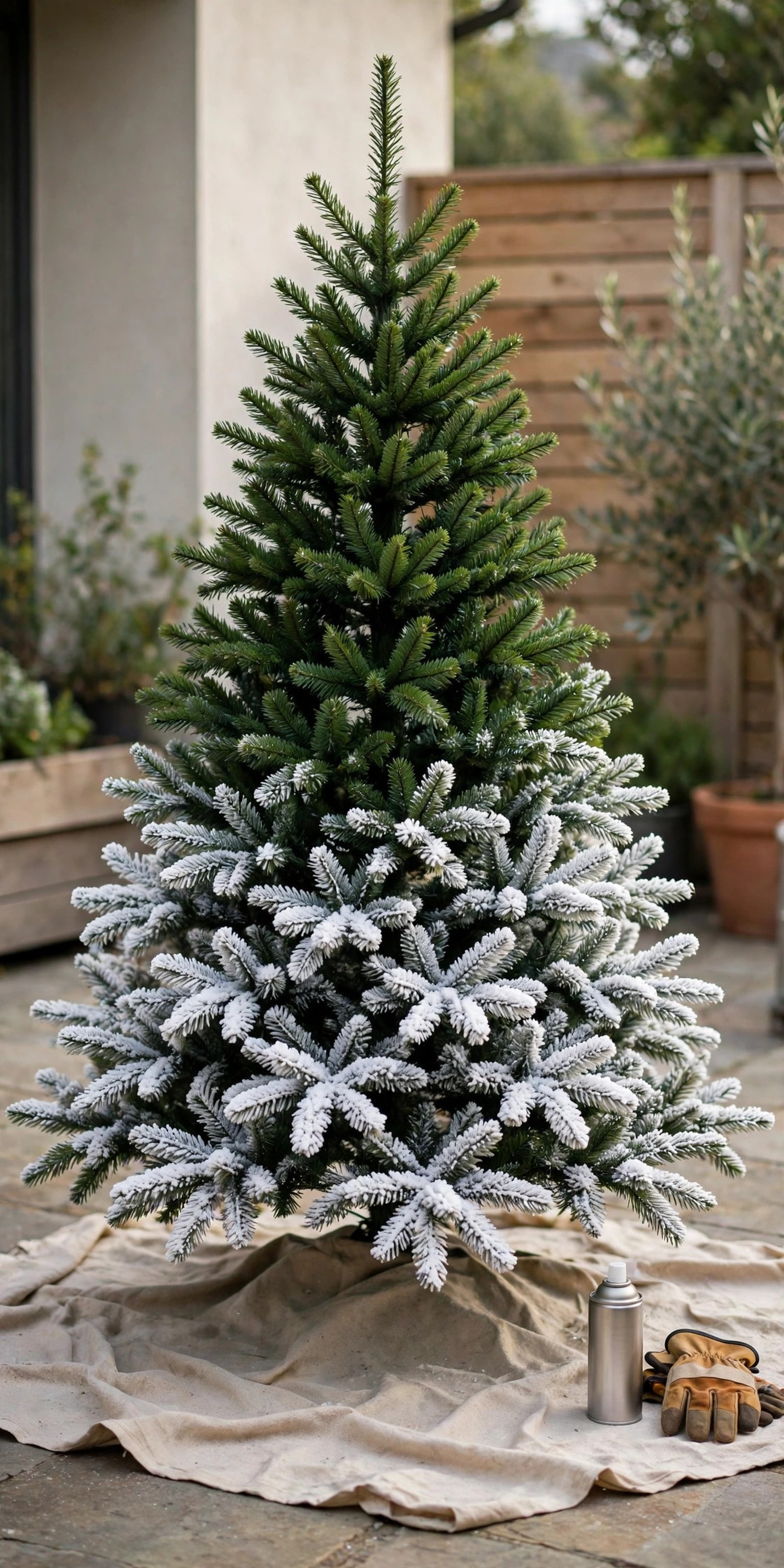
Tip: Practice on one back branch first, at the bottom, facing the wall. By the third branch your hand will know the distance and pace the product wants.
15. Keep the Snow on the Tree: Gentle Hands, Dry Dusting, Careful Storage
Everything about flock care reduces to one idea: the coating is a surface, and surfaces wear. Handle the tree as little as the decorating allows. Wear gloves during setup and takedown — the flocking material can irritate skin with prolonged contact — fluff branches by lifting from underneath rather than pulling tips outward, and keep the tree clear of fireplaces, radiators, and heating vents, since heat yellows the coating and shakes it loose. The care tips in The Garden Style’s flocked Christmas tree guide line up with all of this: gentle hands, dry cleaning, and distance from heat.
Cleaning is dry, always. Dust comes off with a soft brush or a hair dryer on its cool setting, worked gently from top to bottom; water is the one thing to keep away, because it can dissolve and streak the coating. At season’s end, some shedding during takedown is normal — it is not a sign the tree is finished. Store the tree in a proper tree bag in a cool, dry place rather than crushed back into its box, and a good flocked tree will keep its snow for many seasons.

Tip: Vacuum the spot before the tree goes up, not just after it comes down. Starting with a clean floor makes the season’s normal light shedding easy to see — and easy to stay relaxed about.
Frequently Asked Questions
Do flocked Christmas trees shed a lot?
Some shedding is normal, especially the first time you set the tree up and again at takedown — loose fibers from manufacturing and handling work free. Well-made trees shed less, and gentle handling, minimal repositioning, and never dragging garlands or strands across the branches keep most of the snow where it belongs. Expect a light dusting under the tree, not handfuls.
Is flocking safe around pets and kids?
Flocking is generally considered non-toxic, but it is not food: veterinary guidance is that swallowed flocking can upset a pet’s stomach, and larger amounts could cause an intestinal blockage. Discourage chewing on flocked branches, vacuum up shed fibers where pets play, and supervise small children around the tree.
What is the difference between flocked and frosted trees?
Degree. Frosted trees carry a light coating, mostly on the branch tips, with plenty of green showing; heavily flocked trees are coated almost completely white. The lighter the flock, the more the tree decorates like a green tree. Heavy flocking asks for the restrained, palette-led approach in this guide.
How do I clean and store a flocked tree?
Dust it dry with a soft brush or a hair dryer on the cool setting, and never use water, which can damage the coating. Wear gloves for setup and takedown, since the material can irritate skin. Store the tree in a tree storage bag in a cool, dry place, away from heat, which yellows and loosens flocking.
How long does the flocking last?
With proper care — gentle handling, dry dusting, cool dry storage — the flocking on a good-quality tree lasts for several years. Gradual thinning is normal over time, and small worn spots can be refreshed with a touch-up spray.
Final Thoughts
A flocked tree asks for a different kind of decorating: not more, but more deliberate. Choose the palette by how it behaves on white, warm the lights, keep the snowy tips visible, and handle the whole tree like the surface it is. Do those things and the tree does the rest — a snowy tree in the corner makes the whole room feel like the first quiet morning after a snowfall. Pick the palette above that fits your room, start with the lights, and let the snow show.