
12 Warm Minimalist Living Room Ideas on a Budget


Minimalism has a reputation problem. Most people picture a cold white box that nobody actually lives in. But warm minimalism is something else entirely: cream walls, a sofa you sink into, lamplight pooling in the corner at night, texture everywhere you look. It is calm without being empty, simple without being stark.
The best part is that warmth does not require a big budget. You need a ruthless declutter, three warm colors, and the discipline to spend only on the few things that matter. This guide gives you 12 budget ideas in order, starting with the free stuff and ending with the finishing touches, plus the exact $500 breakdown so you can copy the math.
Start with idea #1 this weekend. It costs nothing and changes the room more than anything you will buy. And if you love a good bargain hunt, my thrift store decor guide pairs perfectly with this project.
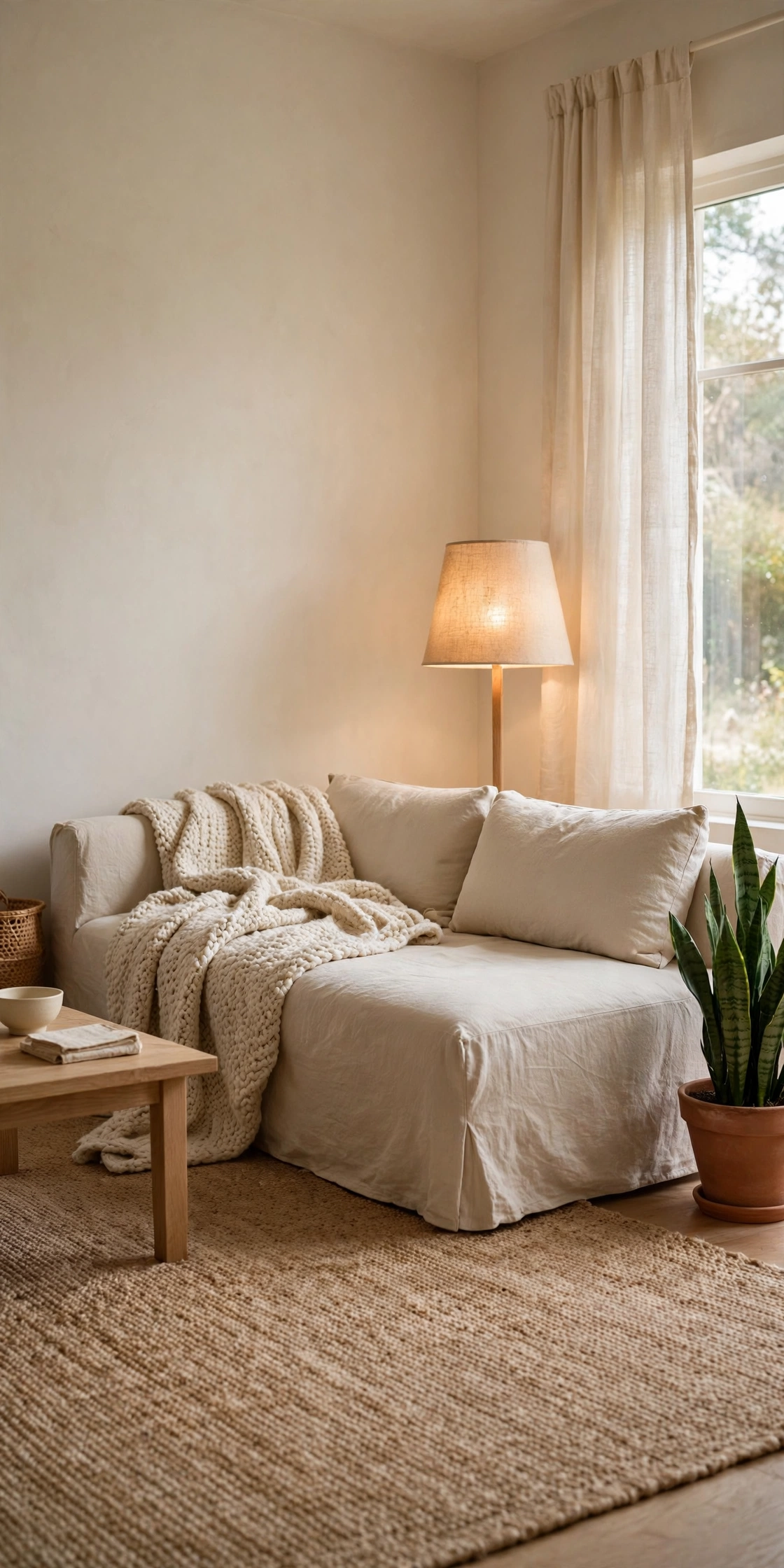
1. Declutter Like You Mean It
Before you spend a single dollar, take out everything that doesn’t earn its place. The stack of magazines from 2019, the candle holders you’ve never lit, the remote controls for devices you no longer own. One Saturday afternoon of honest purging can make the room look better before you’ve bought a single thing.
Run every item through three questions: do I use it weekly, do I love looking at it, does it help the room feel calm? If the answer is no three times, it goes. Minimalism isn’t about owning nothing. It’s about every visible thing being something you chose on purpose.
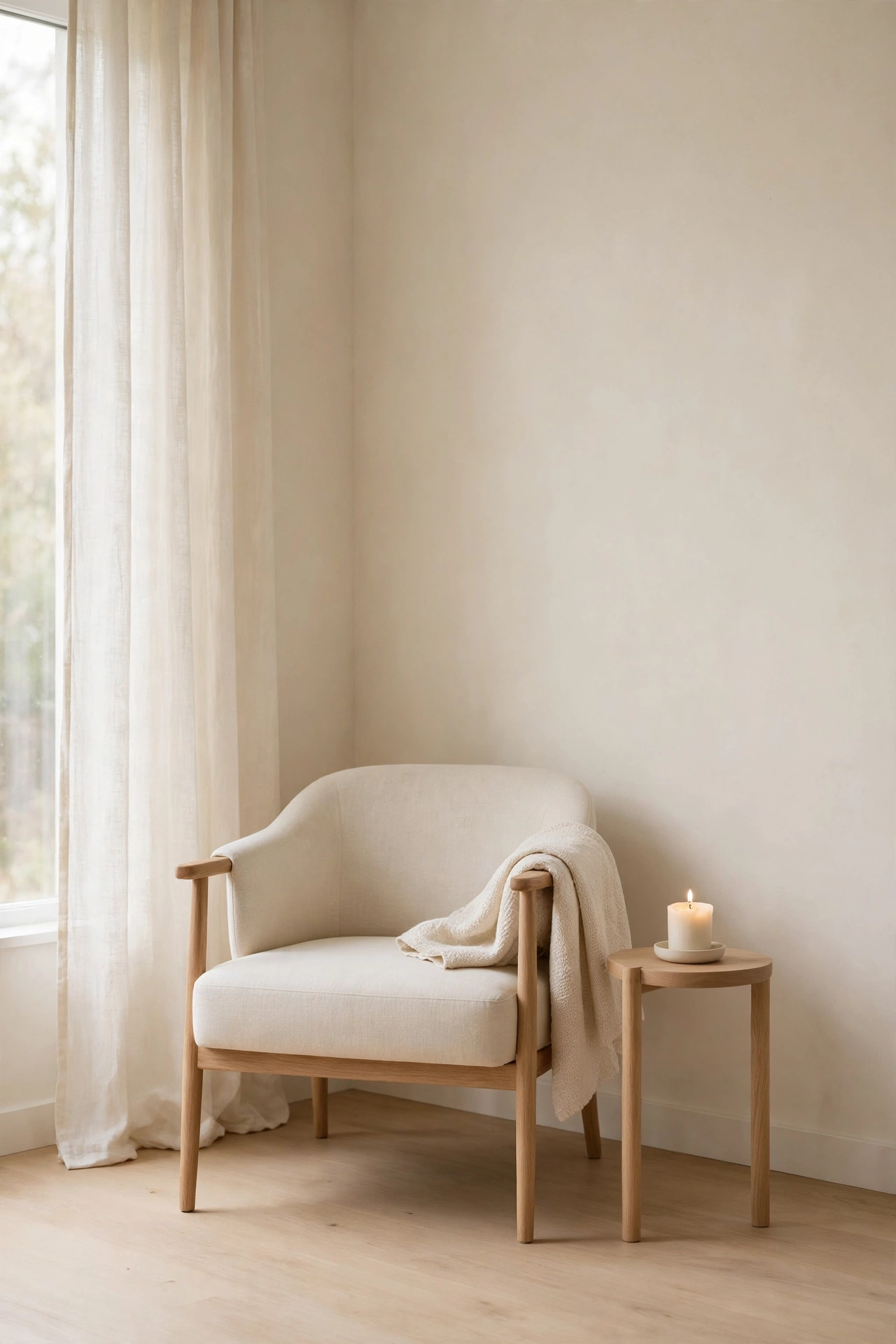
Tip: Don’t just relocate clutter into closets. For the “just in case” items, put them in a box in the garage with today’s date on it. If you haven’t opened it in six months, donate the box unopened. The date on the box removes the guilt from the decision.
2. Pick a Warm Neutral Palette and Stick to It
The difference between cold minimalism and warm minimalism is color temperature. Cold minimalism lives in stark white, cool gray, and black. Warm minimalism lives in cream, beige, oatmeal, greige, and soft wood tones. These colors bounce light around softly instead of throwing it back harshly, and they make a room feel like a hug instead of a showroom.
Give yourself three colors and let them do all the work: a warm white or cream base for walls and large surfaces (60%), beige, camel, or warm gray for the big furniture (30%), and one warm accent like terracotta, honey, or muted rust in small doses (10%). When everything comes from the same warm family, even cheap pieces look intentional.
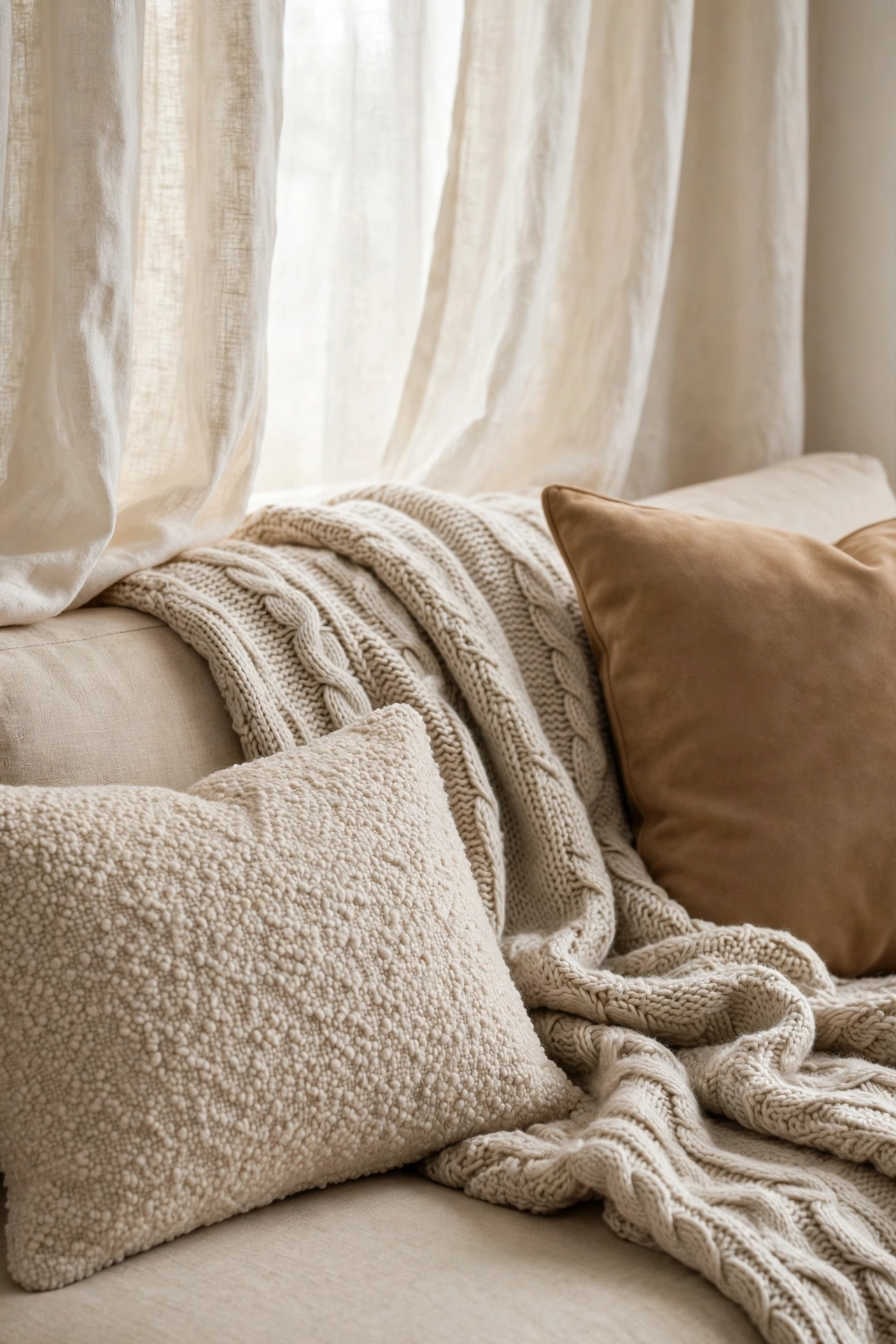
Tip: Renters, you can skip the paint entirely. Cream curtains and a cream rug against plain walls create the same warm envelope as a painted accent wall, and they come with you when you move.
3. Decide Where to Spend vs. Where to Save
With $500 you can’t buy everything, so be strategic. Spend on the things your body touches and your eyes rest on most: the rug (it grounds the room and you feel it under your feet), seating comfort (a good slipcover or cushions on a secondhand sofa), and lighting (warm bulbs change everything).
Save on everything else. Thrift stores are full of beautiful vases and frames, a wooden stool works perfectly as a side table, and you can print free art at the library and frame it in thrifted frames. Nobody can tell the difference once it’s all in the same warm palette.

Tip: Keep the proportions roughly 60% on the big anchors (seating, rug, lighting) and 40% on texture, light, and life. If you already own a decent sofa, that frees up about $165 for a nicer rug or real art. For more small-budget room ideas, see my 10 ways to refresh any room for under $50.
4. Solve the Sofa Problem Secondhand
A new sofa eats a $500 budget for breakfast, so don’t buy one. A sturdy secondhand loveseat with a solid frame can cost around $120, and a stretch slipcover in warm beige runs about $45. That’s $165 total for what looks like a completely different piece of furniture.
When you’re shopping secondhand, ignore the fabric entirely and check only three things: a solid frame (wiggle it, it shouldn’t wobble), comfortable seat depth (sit in it for five minutes), and no weird smells. No good secondhand options near you? Two comfortable accent chairs facing each other, or a pair of oversized floor cushions around a low table, both work beautifully in a warm minimalist room.
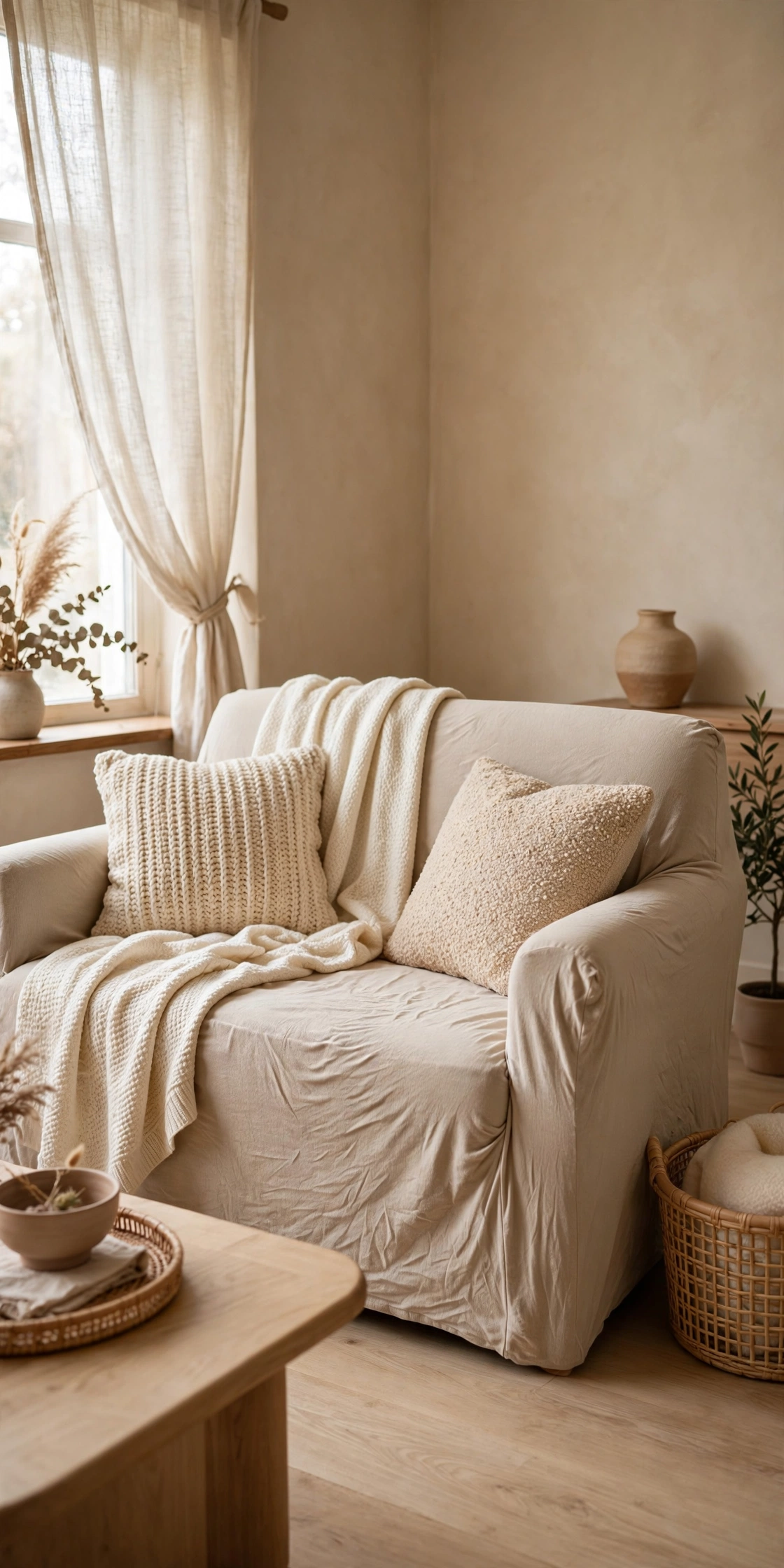
Tip: Whatever seating you choose, drape it with a throw and add two cushions and it will look finished. Seating is about 80% the styling on top of it, which is the cheapest part to get right.
5. Layer Texture, Not Stuff
If warm minimalism has a secret, it’s texture. When your color palette is quiet, texture does all the talking. A cream room with flat, smooth everything looks boring. A cream room with a chunky knit throw, a nubby boucle cushion, a flat-weave jute rug, and a linen curtain looks rich and layered, even though every piece cost under $30.
Use a simple formula: every seating area gets one soft thing (a throw blanket), one nubby thing (a textured cushion), and the floor gets one natural thing (a jute, cotton, or low-pile wool-look rug). Look for waffle weaves, chunky knits, and fringed cotton in cream, oatmeal, or camel.
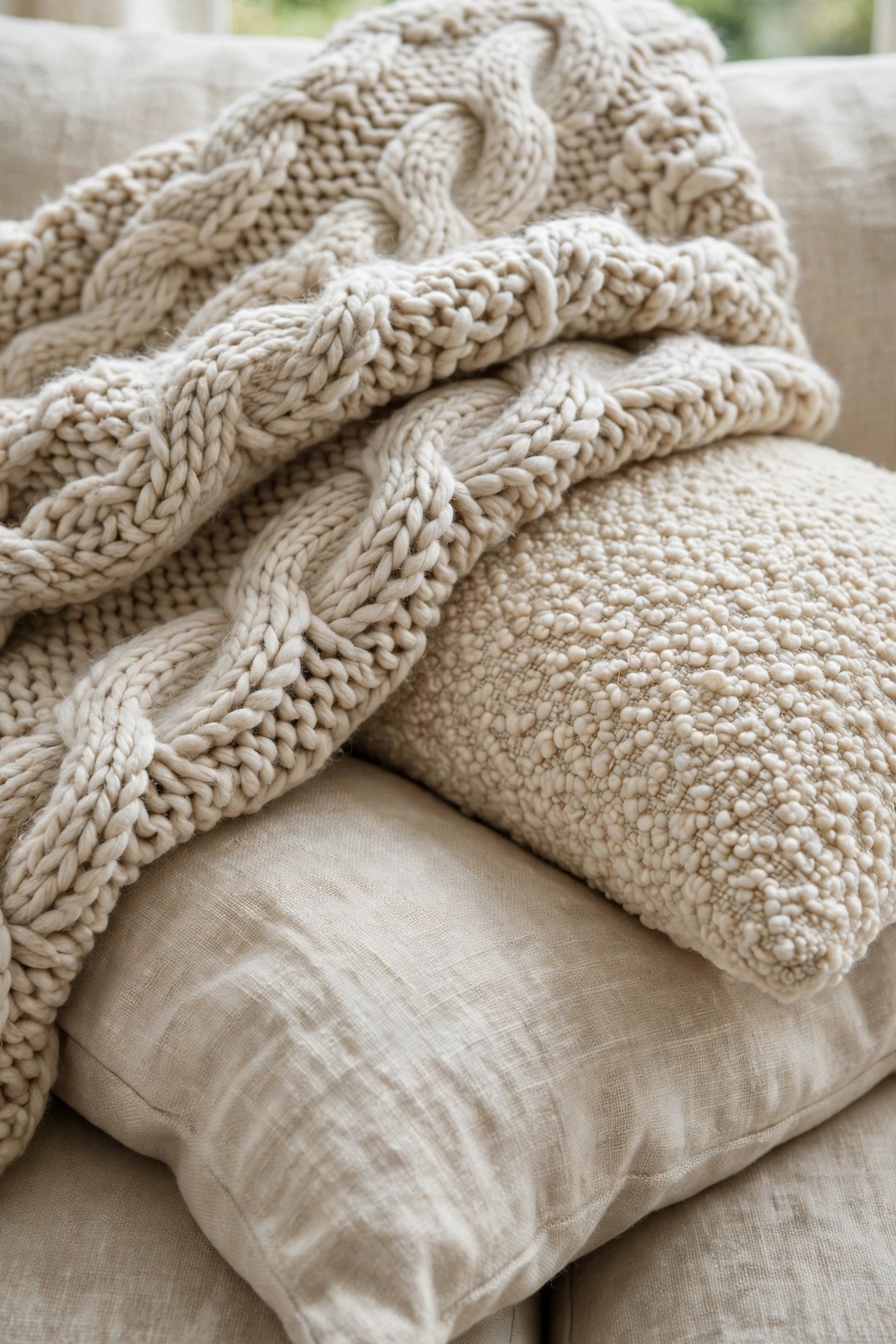
Tip: Stop at two cushions in different textures but the same color family. The third, fourth, and fifth cushion are where minimal goes to die. Restraint is what keeps it minimal. Apartment Therapy’s guide to make a minimalist home feel warm and cozy leans on the same texture-first approach.
6. Get the Rug Right
The rug is the single highest-impact purchase in this whole project. Go as big as your budget allows: a 5×7 foot rug placed under the front legs of your seating makes a small room feel much larger than a tiny rug floating alone in the middle of the floor.
A cotton flat-weave 5×7 in a warm neutral can cost around $90, and it’s the kind of purchase you feel every single day under your feet. It visually anchors the sofa and chairs into one intentional grouping instead of furniture scattered on bare floor.
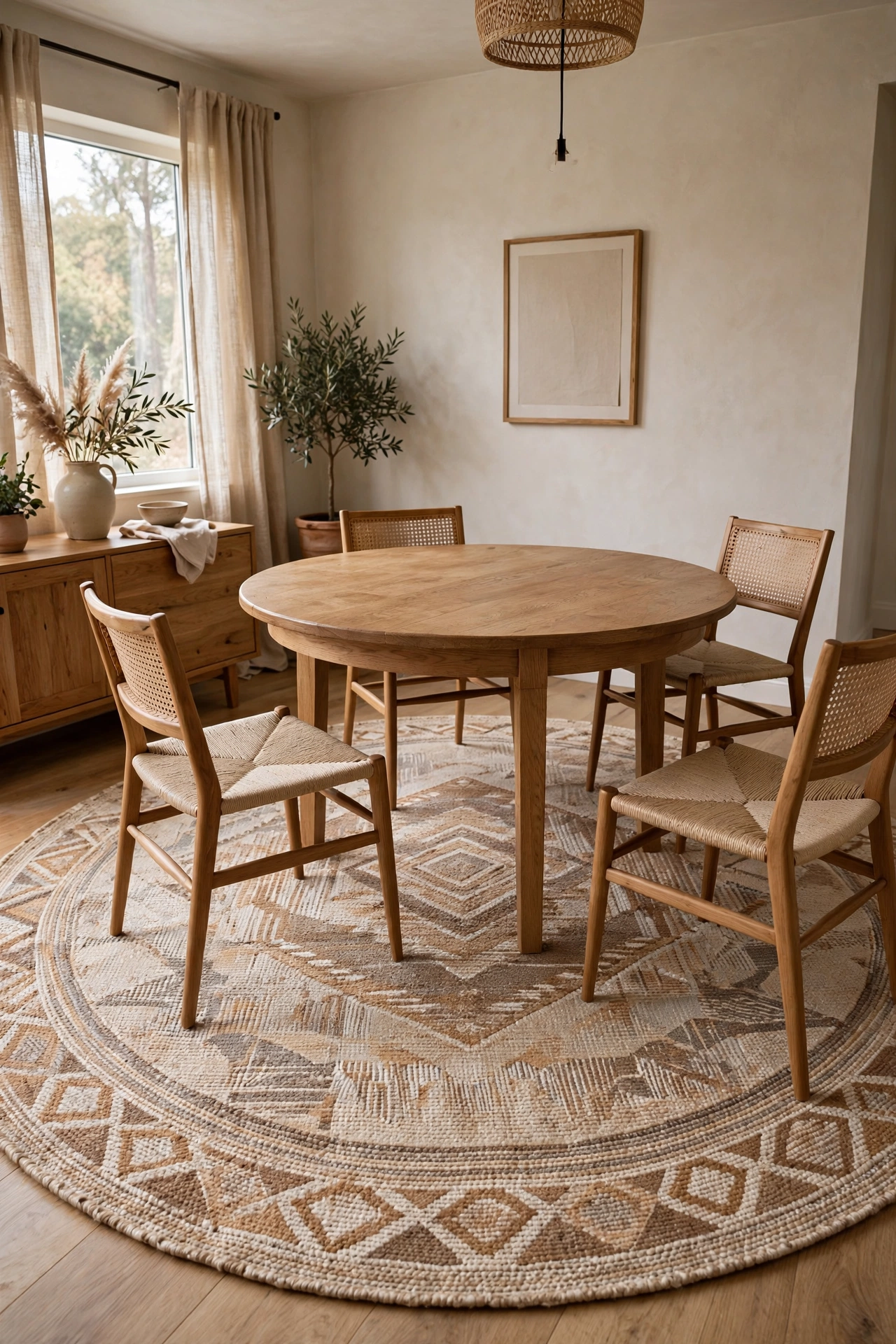
Tip: Measure before you buy. The front legs of the sofa and any chairs should sit on the rug. If only the coffee table fits on it, the rug is too small and it will make the room look choppier, not cozier.
7. Light It Warm, in Layers
Overhead ceiling lights are the enemy of coziness. They blast flat white light from above and make everyone look tired. Warm minimalism needs warm light, around 2700K (check the bulb box, it matters), coming from at least two lower sources: a floor lamp in a corner and a table lamp on a side table or shelf.
In the evenings, turn the ceiling light off completely and just use the lamps. The room will glow. For one more layer of magic, put a $10 string of warm fairy lights in a glass jar or along a shelf. It sounds dorm-room, but in a calm neutral room it looks genuinely beautiful.
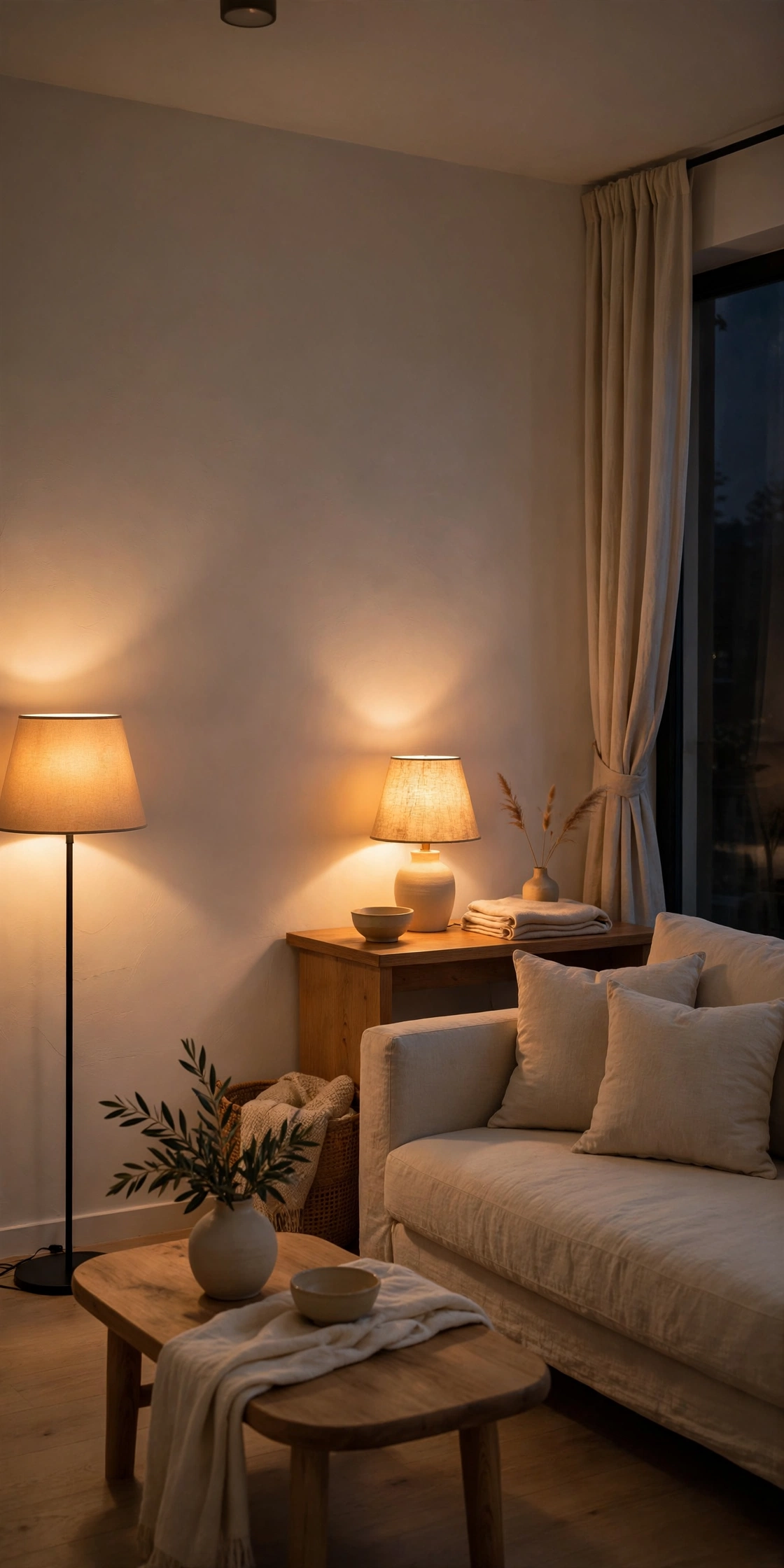
Tip: You don’t need expensive fixtures, just warm bulbs. A $30 secondhand floor lamp with a $15 warm LED bulb outperforms a $200 fixture with cool white bulbs every time. The bulb matters more than the lamp.
8. Maximize Your Daylight
During the day, your best light is free. Keep window sills clear of clutter so nothing blocks the glass, and hang sheer or light linen-look curtains high and wide so the window itself looks bigger and the light spreads further into the room.
The oldest trick in the book still works: put a mirror on the wall opposite the window. It bounces daylight deep into the room and doubles what you get for zero dollars. A thrifted mirror in a simple wood frame fits this palette perfectly.

Tip: Hang curtain rods 4 to 6 inches above the window frame and 3 to 4 inches wider on each side. This one adjustment makes windows look taller, ceilings look higher, and the whole room feel more generous.
9. Bring Something Alive In
Every warm minimalist room needs at least one plant. It’s the cheapest way to add life, color, and a soft organic shape that balances all the straight lines of minimal furniture. You don’t need a jungle. One medium plant in a nice pot is perfect.
Good picks for people who forget to water things: a snake plant (nearly indestructible), a pothos (trails beautifully off a shelf), or a ZZ plant (thrives on neglect). Put it in a simple terracotta, cream ceramic, or woven basket pot and it becomes a design object. With truly zero natural light, a good faux plant is fine.
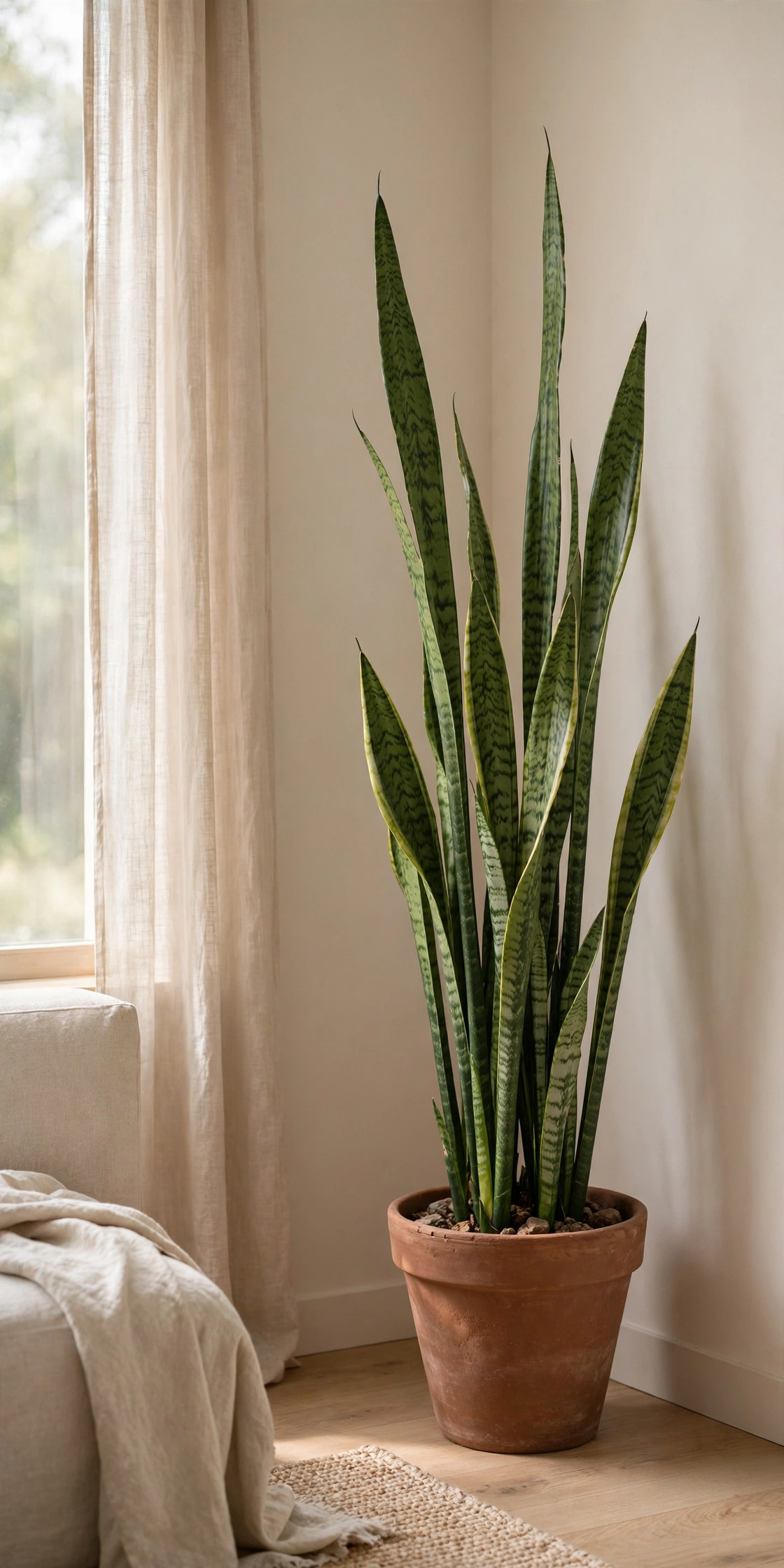
Tip: Match the plant to your habits, not your aspirations. A $15 snake plant you ignore will look better in six months than a $40 fiddle leaf fig you slowly kill. And dust faux plants monthly, kept out of direct “is that real” inspection range.
10. Style Thrifted Decor Like You Meant It
Decor objects are where you save the most. Thrift stores are full of ceramic vases, wooden frames, and candle holders that look far more expensive than their price tags once they’re in a calm, cohesive room. Print free art at the library, frame it in thrifted frames, and hang it with intention.
The trick is curation, not quantity. Three well-chosen thrifted pieces with breathing room around them look like a styled shelf. Fifteen thrifted pieces crammed together look like the store shelf they came from.
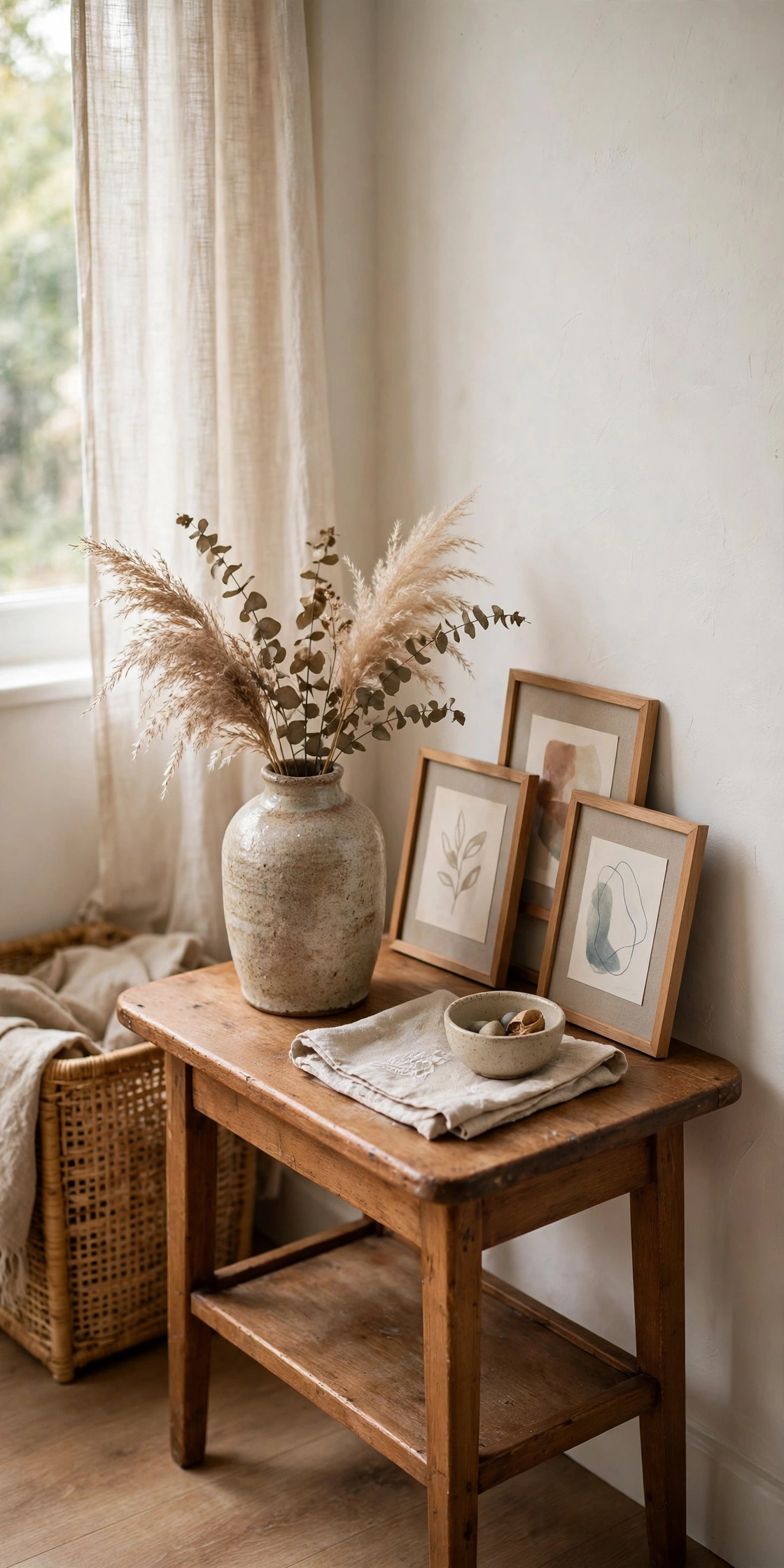
Tip: Stick to your palette at the thrift store. A $20 honey-toned side table looks like a design choice next to your $25 throw blanket in the same tone. Off-palette bargains, no matter how cheap, are what make rooms look cluttered.
11. Add One Warm Accent, Then Stop
Here’s where the warmth really comes from: one accent color, used in small doses. Terracotta, honey, sage green, or muted rust. A cushion here, a throw there, a plant pot, a candle. Small hits of warmth against all that cream and beige.
This is the jewelry of the room. Like jewelry, a little elevates everything and a lot ruins the effect. Pick your one accent and repeat it two or three times around the room so it feels deliberate rather than random.

Tip: If you’re tempted to add a second accent color, don’t. One accent keeps the room calm; two accents start competing and the minimal feeling evaporates. When in doubt, add texture instead of color.
12. Keep It That Way With the 10-Minute Reset
A minimalist room only stays calm if you maintain it, but maintenance doesn’t have to be a project. Every evening, do a 10-minute reset: throws refolded, cushions plumped, mugs to the kitchen, remotes in their basket, one quick fluff of the rug. Because there’s less stuff, there’s less to tidy, and the room greets you calm every morning.
Keep a small basket by the sofa for “homeless items,” anything that wandered in during the day. Once a week, put everything back where it belongs. Five minutes, and clutter never gets a chance to creep back.

Tip: Tie the reset to something you already do, like starting the kettle or the evening news. A habit stacked onto an existing routine sticks; a standalone “tidy the living room” chore gets skipped by Thursday.
Which Budget Upgrade Should You Start With?
Not every idea pays off equally for every room. Use this to pick your first move:
| Project | Difficulty | Best for |
|---|---|---|
| Declutter the room | Easy | Everyone, do this first, it’s free |
| Slipcovered secondhand sofa | Medium | The biggest single visual change |
| Large 5×7 rug | Easy | Small rooms that feel choppy |
| Warm layered lighting | Easy | Rooms that feel cold after dark |
| Thrifted decor styling | Easy | The tightest budgets |
| One healthy plant | Easy | Instant life for dull corners |
Frequently Asked Questions
Can I do this as a renter?
Absolutely. Everything here except the optional accent wall is renter-friendly: slipcovers, curtains, rugs, lamps, plants, and thrifted decor all move with you. My renter-friendly living room tour shows the same approach in a rental.
What if my sofa is dark or patterned and I can’t replace it?
A stretch slipcover in warm beige is the fix. It costs around $45 and works on most standard sofas and loveseats. Measure your sofa first and check the slipcover’s size range before ordering.
How do I keep minimalism from feeling cold?
Three things: warm color temperature (cream and beige, never stark white), layered texture (knit, boucle, jute, linen), and warm 2700K lighting in the evenings. Cold minimalism is usually just cool colors plus overhead lighting.
What should I buy first if I only have $100?
Declutter for free, then put the $100 toward the largest rug you can afford. It’s the one purchase that changes how the whole room feels underfoot and looks in photos.
How long does a budget living room makeover take?
Plan on two to three weekends. Declutter first, then thrift and shop over the next week or two, then style everything in one go. Rushing leads to off-palette impulse buys, which is exactly what the budget cannot absorb.
Is minimalism realistic with kids or pets?
Yes, with the right choices. Washable slipcovers, closed storage for toys, and fewer fragile objects actually make a home easier to keep clean. Minimalism with kids means durable and simple, not precious.
Final Thoughts
A warm minimalist living room isn’t about having less for the sake of less. It’s about making space, literally and mentally, for the life you actually want in that room: long conversations, slow Sunday mornings, a good book, a friend dropping by. Start with the declutter this weekend. It’s free, and you’ll feel the difference before you spend a cent. And if your entryway needs the same treatment next, my small entryway ideas use the same warm-minimal playbook. For more warmth on any budget, these cozy decorating ideas from Apartment Therapy’s designers are worth a browse.


