
9 Small Entryway Ideas for a Big Welcome


The entryway is the hardest-working space in the home: the first thing you see when you come home tired, and the first thing guests see when they visit. Yet so many entryways, especially small ones, end up as a sad pile of shoes, a tangle of coats, and a wall nobody looks at.
Here is the good news: you do not need more space, you need smarter choices. Here are 9 ideas for a big welcome from a small entryway. Each is simple, most are cheap, and none takes more than an afternoon.
Start with idea #1, the mirror. It is the single biggest change per dollar. And if you love secondhand finds for the rest, my thrift store decor guide shows what to grab for entryway styling.
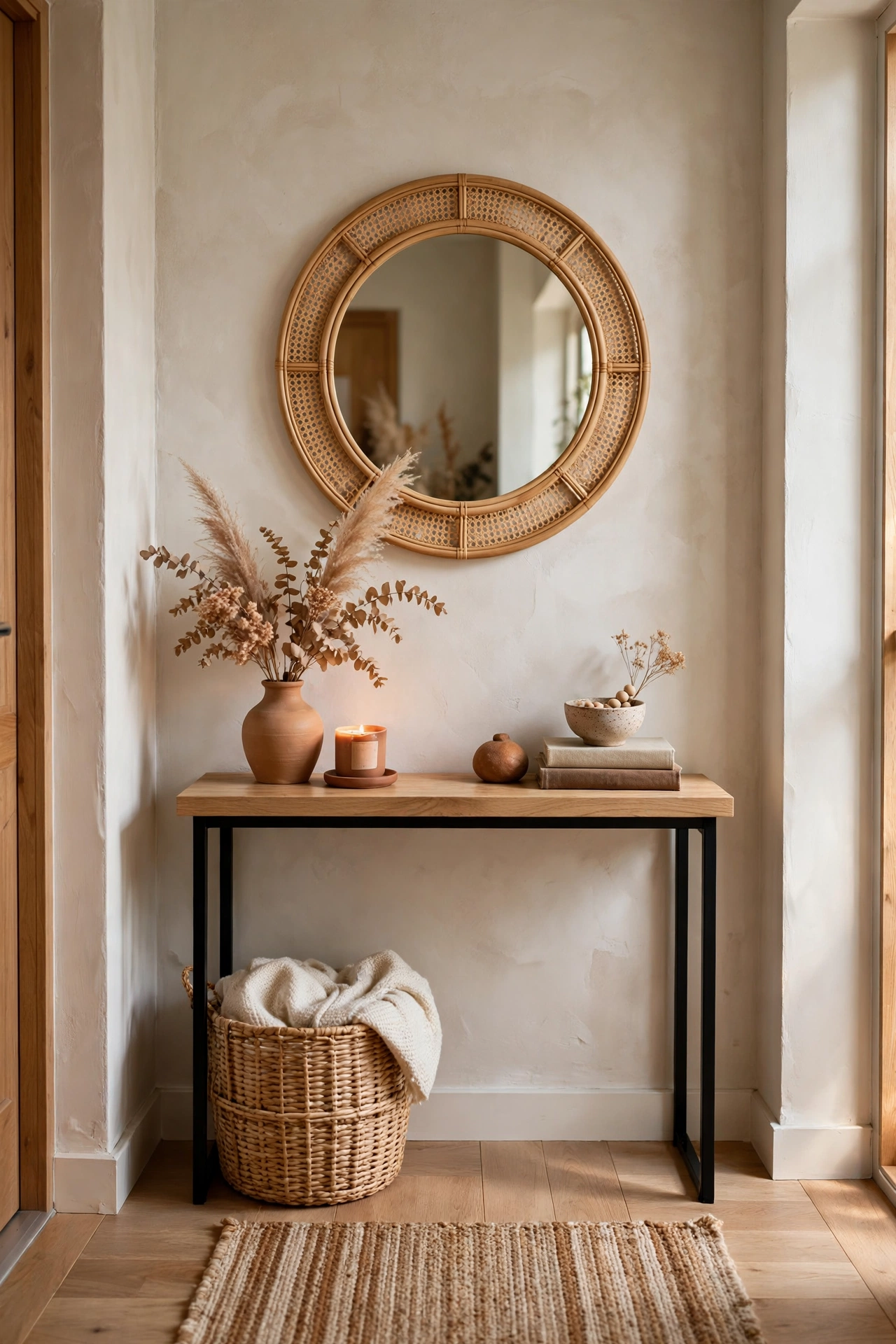
1. Hang a Mirror to Double Your Light
If you only do one thing from this list, make it this one. A mirror is pure magic in a small entryway. It bounces whatever light you have, from a window, a lamp, even the hallway, around the space and makes it feel twice as big. It also gives you that essential last check before you run out the door.
Size matters: go as big as your wall allows. At least 24 inches wide and 30 inches tall makes a real impact; anything smaller looks like an afterthought. Hang it so the center sits at about 60 inches from the floor. Above a console table, center it with 6 to 8 inches between the tabletop and the mirror’s bottom edge. Round mirrors are wonderfully forgiving in tight spaces since they have no corners poking into sightlines.
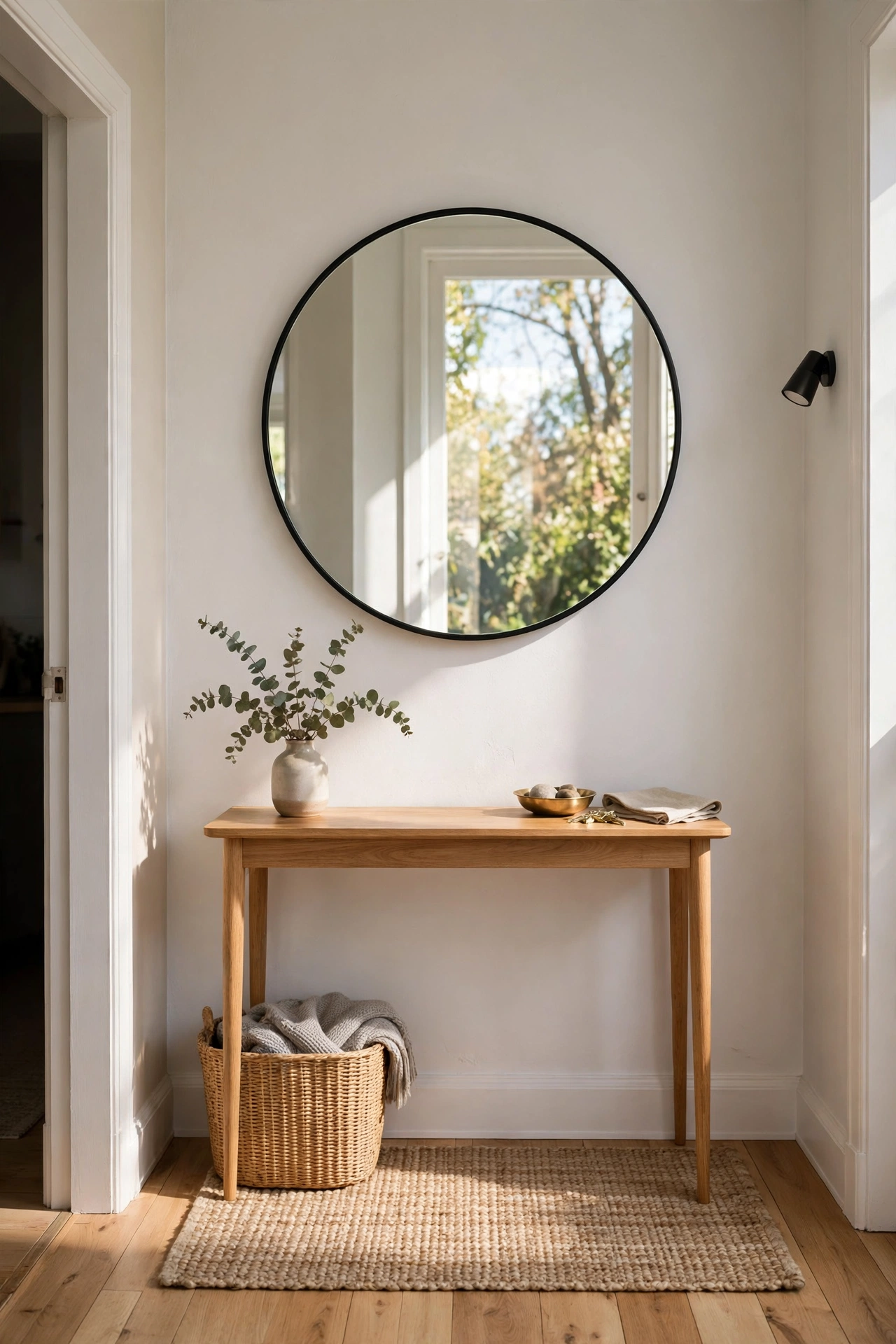
Tip: Thrift the mirror. Big mirrors are one of the best secondhand deals because people practically give away heavy ones when they move. Check the backing is solid and the glass has no dark spots, and you’ve saved $50 or more.
2. Choose a Slim Console Table (or Skip It)
A console table gives keys, mail, and sunglasses a landing spot instead of scattered everywhere. But depth is everything: look for a table no more than 10 to 12 inches deep. Anything deeper eats your walkway and makes the space feel cramped. Standard console height is 30 to 36 inches, comfortable for dropping things as you walk in.
Measure your walkway first. You want at least 30 inches of clear walking space in front of the table, 36 if you can manage. If your entryway can’t spare that, skip the table and mount a small floating shelf instead: 24 inches long, 6 to 8 inches deep, at 36 to 42 inches high. Same landing spot, zero floor footprint. I used a floating shelf for months before finding my slim console, and it worked beautifully.
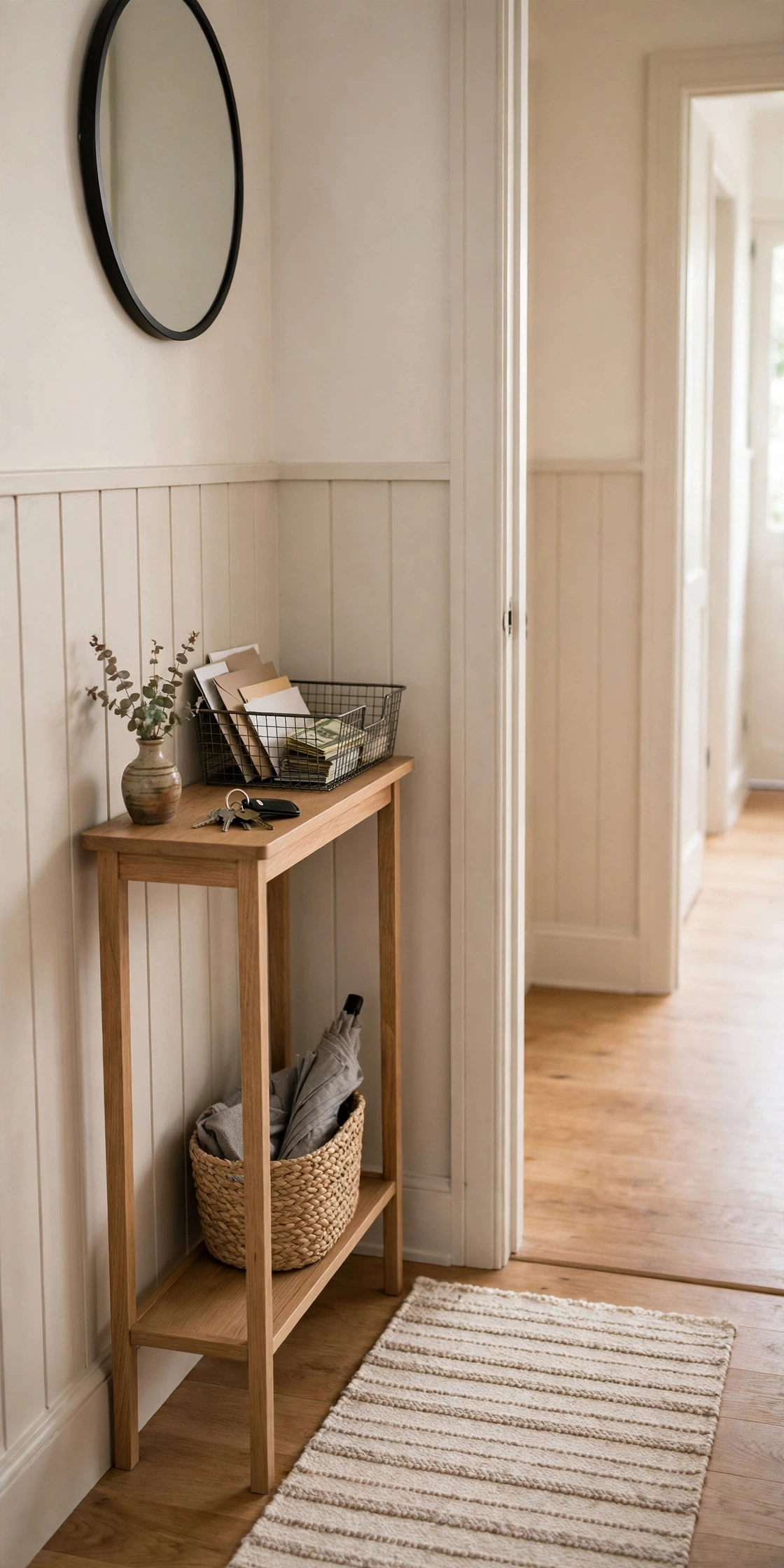
Tip: A narrow bookshelf turned sideways or a wall-mounted drop-leaf shelf also works. The rule is simple: if you have to turn sideways to pass it, it’s too deep. Walkway first, furniture second.
3. Add Hooks for Coats and Bags
Hooks are the unsung heroes of small entryways. A coat closet is lovely, but hooks are faster, which means you’ll actually use them, and coats end up on hooks instead of on chairs. Mount a row of 3 to 5 sturdy hooks, spaced 6 to 8 inches apart so coats hang without bunching.
Mount the main row at 60 to 66 inches for adult coats. With kids, add one or two lower hooks at 36 to 40 inches so they can hang their own backpacks; it genuinely builds the habit. Screw at least the main hooks into a stud, because a row of winter coats is heavier than you think. My rule: one hook per person, plus one spare for guests. When the hooks are full, something goes back in the closet.
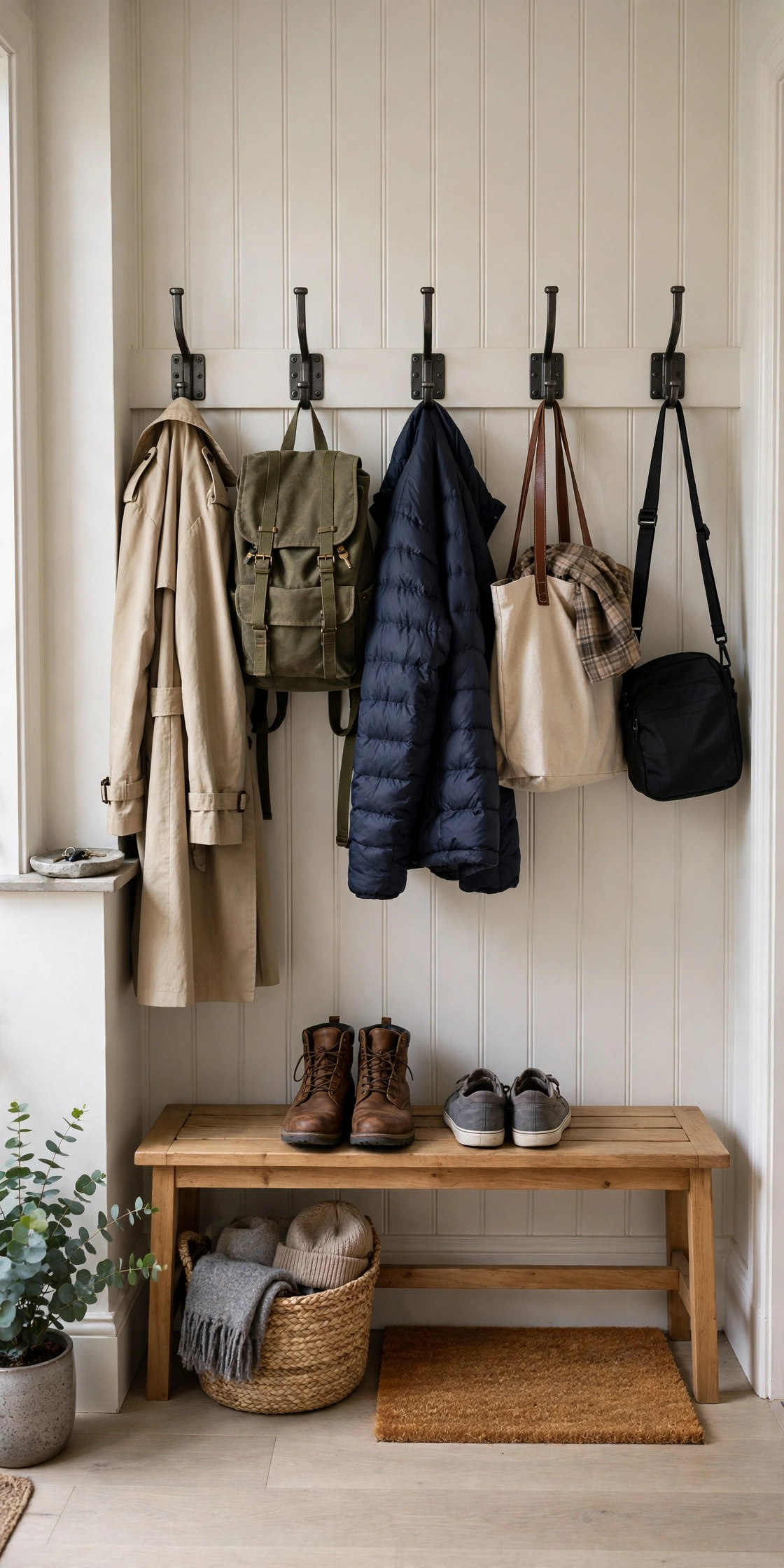
Tip: For renters, heavy-duty adhesive hooks rated for the weight work for light jackets and bags. Test one for 48 hours with your heaviest coat before loading up the whole row.
4. Lay Down a Rug That Fits
A rug does three jobs: catches dirt, feels good underfoot, and tells your brain “this is a defined space” even with no walls. But size is where most people go wrong. A tiny postage-stamp rug in front of the door looks lost and slides around.
For a standard front door, go 2.5 to 3 feet wide and 4 to 5 feet long, big enough for two full steps. For a narrow hallway entry, a runner 2 to 2.5 feet wide and 6 to 8 feet long is ideal. Leave 4 to 6 inches of bare floor on each side so it looks intentional. Choose low-pile and washable, entryways take a beating, and put a non-slip pad underneath, especially on hard floors.

Tip: A washable rug you can throw in the machine is worth its weight in gold for an entryway. Shoes, rain, mud, it all lands here. Washability beats pattern every time in this room.
5. Corral Shoes in a Basket
Shoes are the number one source of entryway chaos. The solution isn’t a giant shoe rack, it’s one attractive basket and a firm rule. Get a sturdy woven basket about 16 to 20 inches wide and 12 to 14 inches tall, big enough for three or four pairs of daily shoes. Place it beside the console table or under the floating shelf.
The rule that makes it work: the basket is for today’s shoes only. Come home, shoes go in. When it’s full, the least-worn pair goes back to the closet. It takes about two weeks to become automatic, and the difference is dramatic: one tidy basket instead of twelve pairs scattered. Bigger household? One basket per person, lined up. Matching baskets look intentional even full of sneakers.
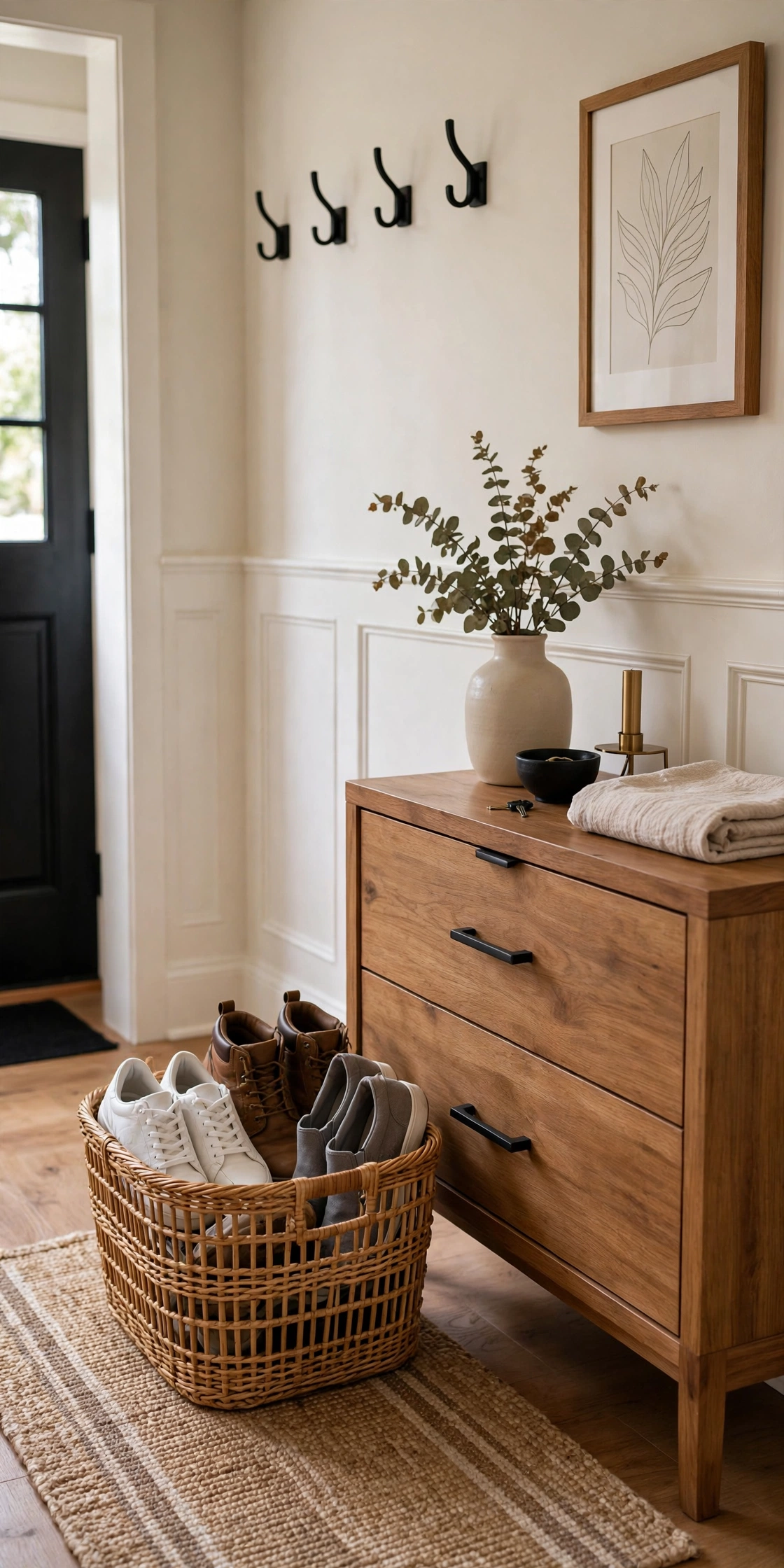
Tip: Put a small washable mat or tray inside the basket for wet shoes. It protects the basket weave and the floor, and you can pull it out and rinse it in seconds.
6. Get the Lighting Right
Most entryways have terrible lighting: one harsh overhead bulb, or nothing at all. Good lighting is what makes a small space feel welcoming instead of cave-like. With room on the console, a small table lamp (12 to 18 inches tall) with a warm-white 2700K bulb instantly makes the corner feel like home.
No table space? Mount a small plug-in wall sconce at 60 to 66 inches high, or use a battery-operated LED picture light above the mirror. Inexpensive, no wiring, and light bouncing off the mirror doubles the glow. Avoid cool-white bulbs; they feel clinical. Warm light says “welcome home” in a way cool light never will.

Tip: Put the entryway light on a timer or smart plug so it’s lit when you arrive. Walking into a warmly lit entryway after a long day is a small daily joy, and it costs almost nothing to automate. I use the same warm-bulb approach in my living room.
7. Add a Scent
Smell is the first thing guests notice and the last thing we think about. An entryway that smells good, subtly, not overpoweringly, feels clean and cared for before anyone looks around. A reed diffuser on the console or shelf is my favorite: no flame, no outlet needed, and one lasts for months. Place it toward the back so it doesn’t get knocked over.
Choose fresh and simple over heavy or sweet: citrus, eucalyptus, clean linen, or light pine. One diffuser is enough for a small entryway. This is a whisper of scent, not a perfume counter. A small candle works too if you’ll actually blow it out, and dried lavender or eucalyptus stems look pretty while adding faint natural fragrance.

Tip: Skip overpowering plug-in air fresheners. In a tiny space, strong artificial scents hit like a wall. Subtle always wins, and guests notice “fresh” far more than they notice a specific fragrance.
8. Bring in One Small Plant
A little green makes any space feel alive. One small plant on the console or shelf is perfect. The trick is choosing something that tolerates entryway conditions: inconsistent light and occasional neglect. My top picks are pothos, snake plants, and ZZ plants, all famously hard to kill in low to medium light.
A 4- to 6-inch pot is the right scale for a slim console; anything bigger overwhelms the surface. With zero natural light, go faux without guilt. A good faux plant in a pretty pot looks better than a dying real one. I have a faux eucalyptus stem in my darkest corner and nobody has guessed. Place it at one end of the console, not the middle, so it frames the arrangement instead of blocking the mirror.
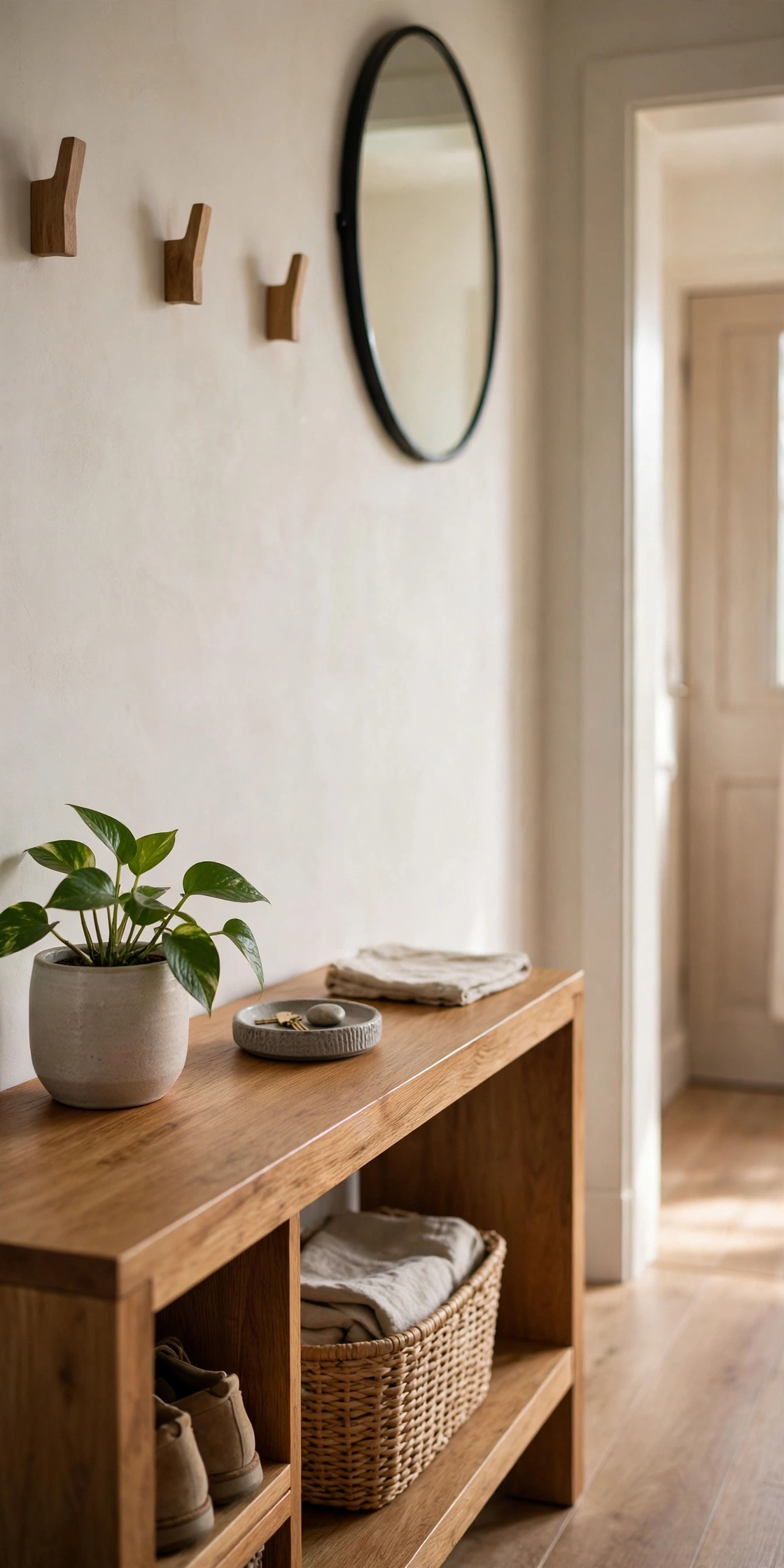
Tip: If your entryway is truly dark, a faux plant plus a real one you rotate monthly works well. Swap in a live plant from a brighter room for a few weeks, then rotate. Both stay happy.
9. Keep Clutter Down With the One-Minute Rule
This is the idea that holds the other eight together. Every time you walk through, spend one minute putting things where they belong: mail in the tray or recycling, shoes in the basket, coat on its hook, bag on its spot. One minute. That’s it.
A small entryway has no margin for clutter. In a big mudroom a pile of mail sits unnoticed; in a four-foot entryway it’s the first thing everyone sees. The one-minute rule works because it’s too small to talk yourself out of, and it stops the slow creep back into a dumping ground. I also do a two-minute Sunday reset: wipe the console, shake out the rug, toss dead leaves, check the basket for strays.
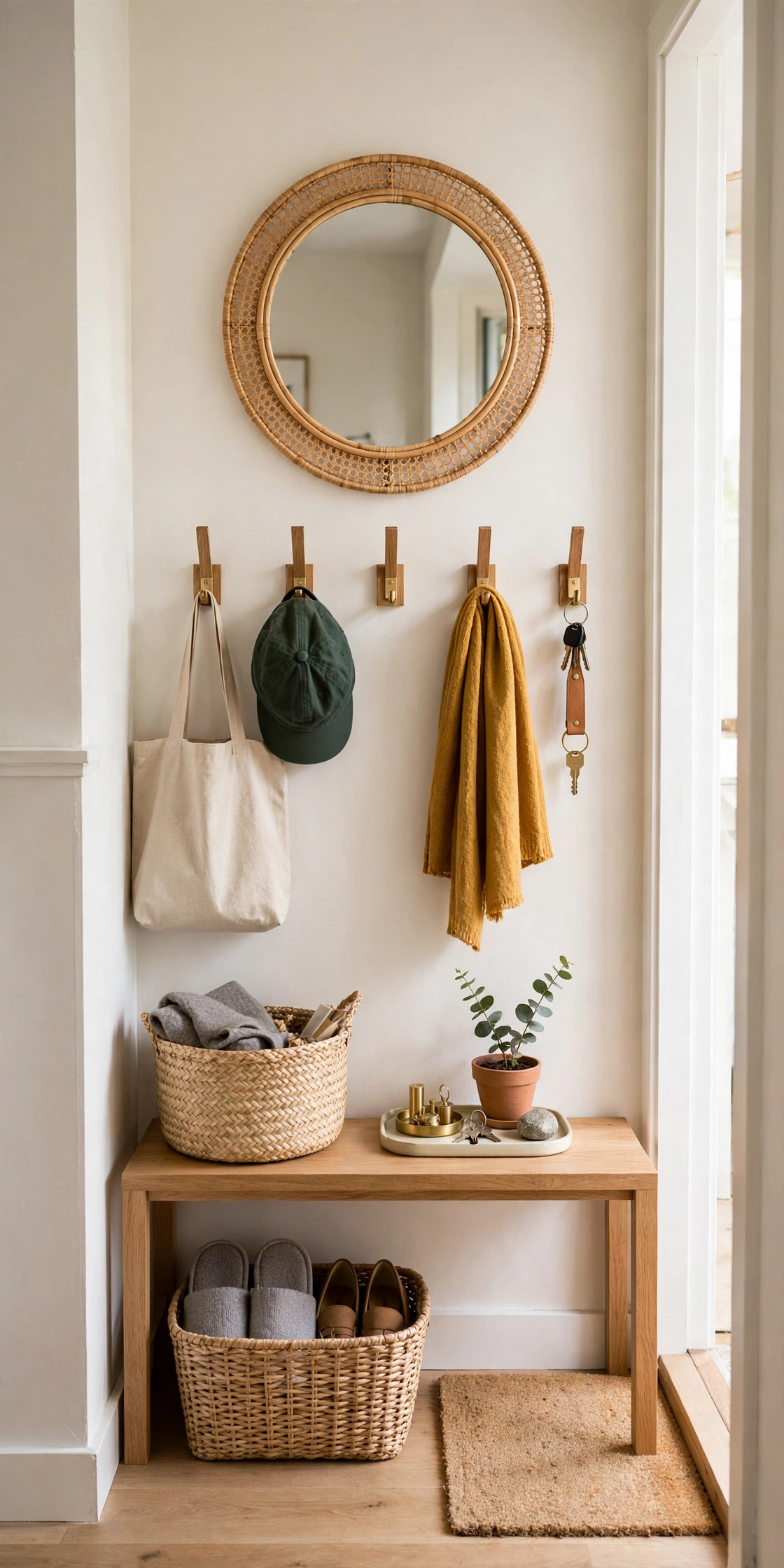
Tip: Keep a small recycling bin or shred bag right by the door for junk mail. Most entryway paper clutter is mail you never needed. Touch it once: recycle, file, or act. The bin makes “once” easy.
Which Entryway Fix Should You Do First?
Start with the highest-impact, lowest-effort wins:
| Project | Difficulty | Best for |
|---|---|---|
| Hang a big mirror | Easy | Everyone, biggest change per dollar |
| Row of wall hooks | Easy | Coat chaos, families |
| Shoe basket + rule | Easy | Shoe explosions |
| Right-sized rug | Easy | Undefined, cold spaces |
| Warm lamp or sconce | Easy | Dark, cave-like entries |
| One-minute tidy rule | Free | Keeping it all working |
Browse more small entryway ideas from HGTV for every layout. HGTV’s guide on how to decorate a small entryway shows the same mirror-first approach.
Frequently Asked Questions
How do I stop shoes from taking over?
One basket, one rule: today’s shoes only, and when it’s full the least-worn pair goes back to the closet. One basket per person for bigger households. The rule matters more than the basket.
What if there’s no room for a console table?
Mount a floating shelf instead: 24 inches long, 6 to 8 inches deep, at 36 to 42 inches high. Same landing spot for keys and mail with zero floor footprint. You need 30 inches of clear walkway in front of any furniture.
What’s the best hook option for renters?
Heavy-duty adhesive hooks rated for the weight, tested 48 hours with your heaviest coat first. For a bigger statement, a leaning coat rack needs zero holes at all. More ideas in my renter-friendly tour.
How do I make a tiny entryway feel bigger?
Mirror for light, light colors, and nothing on the floor except the rug and basket. Visual clutter shrinks a space faster than actual size does. My room refresh ideas under $50 have more small-space tricks.
How do I add light with no wiring and no table space?
Mount a small plug-in wall sconce at 60 to 66 inches high, or stick a battery-operated LED picture light above the mirror. Both are inexpensive and need no electrician. Put the light on a timer or smart plug so the entryway glows when you arrive home.
What if my entryway has no closet at all?
Hooks and a basket carry the whole load. Mount one hook per person plus one spare for guests, and when the hooks fill up, something goes back to the bedroom closet. A single sturdy basket holds the daily shoes. No closet just means stricter rules, not more furniture.
Final Thoughts
The real secret of a welcoming small entryway isn’t perfect furniture or big spending. It’s a mirror that catches the light, a place for your keys, hooks that get used, a rug under your feet, and sixty seconds of tidying as you walk through the door. Start with the two or three ideas that made you think “I could do that this weekend,” maybe the mirror, the basket, and the hooks. Live with them a week, then add the next one. Before you know it, the smallest room in your house will give the biggest welcome.


